OTTAWA – The Conservatives have joined the Liberals in voting on a motion to pass a massive bill on major project approvals in the House of Commons by the end of the week. The bill would grant the federal government sweeping powers, including the ability to override laws on projects that are “of national interest,” particularly to eliminate interprovincial trade barriers in response to tariffs imposed by Donald Trump’s U.S.
So, to defende Canada in the “trade war”, three hundred and five Conservative and Liberal MPs voted in favour of the government’s motion on time allocation to limit debate on the bill, while 30 Bloc Québécois, Green and NDP MPs and Liberal Nathaniel Erskine-Smith voted against it. The federal government is determined to pass this bill, C-5, nicknamed the “One Canadian Economy Act,” in the House of Commons before MPs leave Ottawa for the summer recess. With the support of the Conservatives, it looks like the federal government will succeed.
Now, the Federal Standing Committee on Transportation, Infrastructure and Communities is scheduled to hold two meetings to consider the bill before reporting to the House on Friday, ahead of passage.
The unprecedented Conservative-Liberal alliance went even further, voting against a Bloc Québécois amendment that would have given the committee two full days to consider the legislation. The Bloc Québécois, NDP and Greens say the Liberals’ motion on time allocation is undemocratic and does not give MPs the time they need to study and fully understand the legislation. The section on major project approvals alone would give the federal government permission to ignore thirteen existing laws and seven regulations for projects deemed “of national interest.” Many of those laws and regulations relate to the environment. The bill would also allow the federal government to conditionally approve projects it deems “of national interest” before an environmental or impact assessment or other regulatory process is initiated. Review processes will continue to occur, but they will focus on “how” a project should be done rather than “whether” it can be done.
For their part, Liberal MPs, government ministers and House leader Steven MacKinnon justified the motion by saying the government was elected with a mandate to move quickly on projects of national interest and remove federal trade barriers. For their part, Liberal MPs, government ministers and House leader Steven MacKinnon justified the motion by saying the government was elected with a mandate to move quickly on projects of national interest and remove federal trade barriers.
To allay concerns, Liberal ministers and MPs repeatedly referred to a set of “criteria” used to determine whether a project is considered “of national interest.” Factors the government might consider include whether a project advances the interests of indigenous peoples and contributes to “clean growth.””To allay concerns, Liberal ministers and MPs repeatedly referred to a set of “criteria” used to determine whether a project is considered “of national interest.” Factors the government might consider include whether a project advances the interests of indigenous peoples and contributes to “clean growth.”
Among the factors the government might consider are whether a project advances the interests of indigenous peoples and contributes to “clean growth…”. The latter has been met with skepticism because Prime Minister Mark Carney has promoted a tar sands lobby group’s proposed carbon capture megaproject as an example of a potential project of national interest. However, Carney has also said that his government will not impose a project on a province. That’s not specifically stated in the bill, though: Carney’s word is the only guarantee that provinces won’t have to impose a pipeline or other project on their jurisdiction. But that verbal commitment isn’t enough to protect provincial sovereignty, Bloc Québécois MPs say.
If all goes according to the federal government’s plan, Bill C-5 will pass its third reading on Friday and be sent to the Senate, where it will undergo a similar process of study and possible amendments. The Senate sits a week longer than the House of Commons; its last possible sitting day is June 27, compared to June 20 for MPs. The bill could therefore be passed before the summer recess.
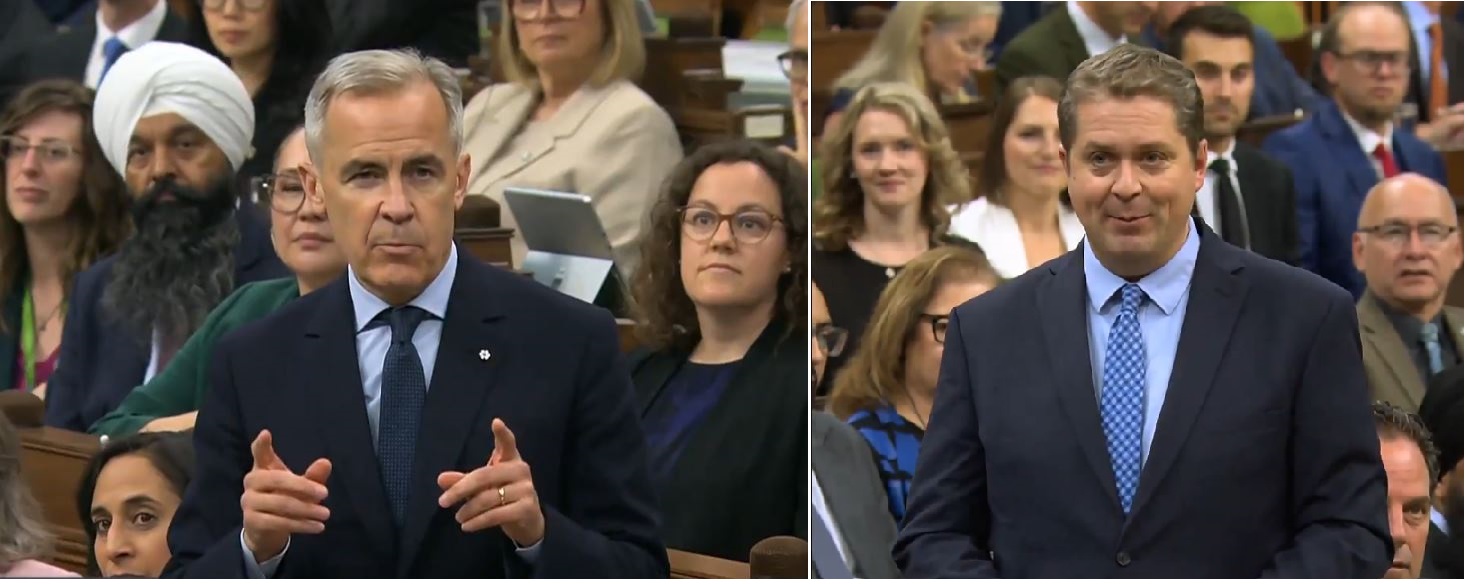
In the pics above, from left: Prime Minister Mark Carney and Conservatives Leader Andrew Scheer (from Twitter X – @AndrewScheer)
(files from The Canadian Press)