
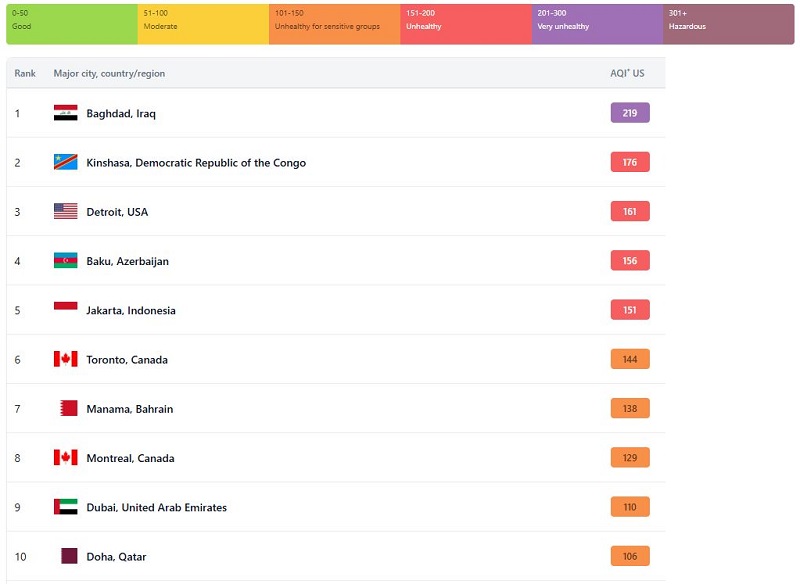
TORONTO – Toronto’s air quality continues to hold a grim record: it is among the worst in the world, according to the Swiss air quality monitoring institute IQAir, which conducts real-time air quality monitoring and can be consulted here. At 8:50 a.m. this morning, Toronto was the second most polluted city in the world; by midday, the city had dropped, but remained in the top 10 most polluted cities, tied with Montreal. At that time, Canada was the only country in the world with two cities in the top ten for worst air quality and it still is while we are writing this article, at 1.30 pm of August 4, 2025.
The problem, once again, is smoke from the wildfires raging in Ontario and the rest of Canada, which, according to Environment Canada, will affect much of southern Ontario until Tuesday before dissipating (at least in Toronto).
The fact is that at 6 a.m. this morning, according to Air Quality Ontario, the Air Quality Index (AQHI) for downtown Toronto was 6, representing a moderate risk. It then peaked at 7, representing a high risk, before dropping to 5 in the evening. Tomorrow, it is expected to be 4, representing a moderate risk.
Air quality and visibility due to wildfire smoke can vary over short distances and significantly from hour to hour. Therefore, Environment Canada urges people to limit time spent outdoors and consider reducing or rescheduling any outdoor activities due to smoke levels. This advice is especially important for those most at risk, such as seniors, pregnant women, and children, or those with persistent or chronic medical conditions.
But how can you tell if the air is polluted by wildfire smoke? What exactly does it feel like? Some common symptoms include irritation of the eyes, nose, and throat, headache, or a mild cough, according to the federal agency. While not as common, Environment Canada says wheezing, chest pain, or a severe cough are also potential symptoms. In all these cases, Environment Canada recommends keeping windows and doors closed as much as possible to prevent wildfire smoke from spreading into your home.
If anyone must spend time outdoors, it’s recommended to wear a well-fitting respirator to reduce exposure to fine particles in smoke.
Air quality expert Jed Kaplan, interviewed by CP24 on Sunday, raised the alarm about the effects of fine particulate matter produced by Canadian wildfires, noting that it can penetrate deep into the lungs. “It’s especially bad to be outside under those kinds of smoky conditions,” Kaplan told CP24‘s Sijia Liu. “If you’ve got air con or if you have an air purifier, be using it for sure. If you don’t have a purifier, consider going to the library or mall, any place that’s considered going to likely have clear air…”.
To stay updated on Toronto’s air quality index, Torontonians can visit airhealth.ca while for Montreal this is the interactive map: https://carte-qualite-air.montreal.ca/
In the graphic above, the “top” ten” from the IQAir website at 13.31 (local time in Toronto) today