TORONTO – The Bank of Canada has cut its interest rate for the second consecutive time of a 0,25, to 2.25%: a decision predicted by private sector economists and taken due to the persistent weakness of the economy, combined with forecasts that the rate cut will remain close to the 2% target.
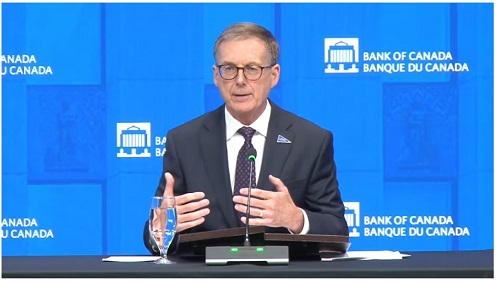
Speaking today in Ottawa, Bank of Canada Governor Tiff Macklem said that the overall 100 basis point rate cuts since January (from 3.25% to 2.25%) are intended to help the economy in what he calls a “period of adjustment”. He argued that U.S. tariffs and trade uncertainty have weakened the Canadian economy, adding costs for many businesses and putting upward pressure on inflation. “The weakness we’re seeing in the Canadian economy is more than a cyclical downturn” Macklem said. “It is also a structural transition” Macklem said. “It is also a structural transition…”. And the trade turbulence caused by the constant changes in mind (and mood) of US President Donald Trump forces the Bank of Canada to be cautious in its forecasts, given the high level of unpredictability.
In any case, in its first Monetary Policy Report, with a baseline projection starting in January, the Central Bank itself states that changes in US trade policy will have a lasting negative impact on economic activity. In the first half of the year, the trade conflict led to a sharp increase in uncertainty, which, according to the bank, contributed to a decline in GDP, a decline in exports and business investment, and a rise in unemployment. “The entire path for GDP is lower than it was before the shift in U.S. trade policy” Macklem stated. In the second quarter, GDP contracted by 1.6%, steel and aluminum exports fell by about 25% compared to the previous year, while overall exports fell by about 5% in the second quarter compared to the previous year: the largest decline was in spending on machinery and industrial equipment. During the same period, consumer spending increased largely due to a spike in vehicle purchases. Residential investment also increased, with rising home sales and construction starts.
Meanwhile, annual inflation unexpectedly jumped in September, rising from 1.9% the previous month to 2.4%, driven primarily by gasoline and food prices. Core inflation, which excludes volatile components such as food, energy, and mortgage interest costs, remains within the Bank of Canada’s target range of around 3%. According to the Central Bank, inflation is expected to stabilize around 2% in early 2026 and remain there until 2027, but the impact of tariffs and trade uncertainty will continue into next year.
The only certainty is that the Bank of Canada’s next rate decision is scheduled for December 10th.
In the pic above, Bank of Canada Governor Tiff Macklem during today’s conference (screenshot from the video of the press conference – here below)