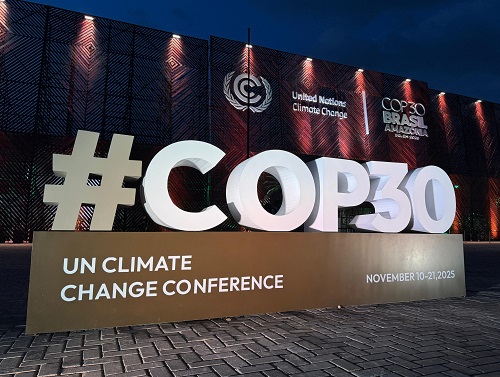
BELEM (Brazil) – COP 30 has once again proved to be a flop, as was the case with COP 29 last year in Baku, Azerbaijan (as we wrote here). This time, the United Nations Conference of the Parties on climate change — held in Belem, Brazil, a few days ago — almost collapsed, but a compromise was ultimately reached: a final political agreement was unanimously approved by the 195 states that participated in the conference (with Donald Trump’s United States absent). But it’s a sham agreement: there is no explicit reference to a roadmap for phasing out fossil fuels, such as coal, oil, and gas.
Among the agreement’s key points are measures to accelerate climate action, a review of related trade barriers, and a commitment to triple (to $120 billion in 2035) funding for developing countries to help them withstand extreme weather events.
“We can’t eat money” said Gilmar, an indigenous leader from the Tupinamba community near the lower Tapajos River in Brazil, who uses only one name, referring to the emphasis on funding. “We want our lands to be free from agribusiness, oil exploration, miners, and illegal loggers…”. The indigenous people brought their protest to the COP, experiencing some tense moments. They then issued a joint statement emphasizing the importance of protecting indigenous territories in the Amazon by excluding them from mining and other activities, along with the Congo basin in Africa and the Borneo-Mekong basin in Southeast Asia.
Amidst tension and controversy, the issue of fossil fuels threatened to make the COP30 in the Amazon—the first to be held after scientists demonstrated that the 1.5-degree limit of global warming set by the Paris Agreement will be exceeded—appear to be the only one to end without an agreement. In the drafts circulated before the final one, the term “fossil fuels” had already disappeared entirely under pressure from Russia, India, and Saudi Arabia, as French Environment Minister Monique Barbut noted. Over thirty countries, including Colombia, France, the United Kingdom, and Germany, had then threatened to veto the resolution, dragging the proceedings out beyond the end of the summit. Then came the compromise, excluding any explicit reference to the fossil fuel phase-out schedule.
For Italian Environment Minister Gilberto Pichetto Fratin, the agreement reached is the only truly possible one: “In a geopolitical moment like the current one, where an era has ended and global political interests and balances, and therefore alliances, are very different from the past, I must say it was the only feasible solution, so it should be viewed positively, with satisfaction..”. The roadmap for the transition from fossil fuels, he added, “is not part of the COP30 document because half the countries did not share this position…”.
Canadian Environment Minister Julie Dabrusin was also optimistic: “Canada came to COP30 to help deliver real progress, and we are leaving with renewed ambition and deeper partnerships to accelerate global climate action” (here her full statement) said the Minister of the country that, according to the Production Gap Report, is one of the world’s biggest polluters (to download and/or read the report, click here).
Photo: Facebook page of COP30