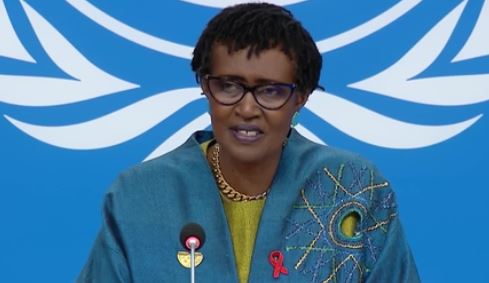
OTTAWA — Canada is cutting, for the first time, its contribution to the Global Fund, a major program for fighting infectious diseases in the world’s poorest countries. And the head of the United Nations HIV/AIDS program, Winnie Byanyima (in the pic above, from her Twitter profile – @Winnie_Byanyima), is urging Prime Minister Mark Carney to reverse his government’s planned cuts to foreign aid and global health funding.
“My message to Prime Minister Carney, to Canada, and to all the other donors is, stay the course” UNAIDS executive director Winnie Byanyima told The Canadian Press on the sidelines of last week’s G20 leaders’ summit in Johannesburg. “Without global solidarity, the inequality between countries will continue to widen. We will live in a more dangerous world as these inequalities increase…”.
Last week, Carney announced Canada’s first-ever cut in funding for the Global Fund: the new commitment is 17% lower than Ottawa’s last contribution to the fund in 2022. The decision came just weeks after the federal budget called for $2.7 billion in cuts to foreign aid over four years, and months after Carney, during the spring election campaign, promised that his government “would not cut foreign aid…”. Then, as politicians typically do when transitioning from candidate position to elected office, Carney also changed his mind, claiming that the aid cuts bring spending back into line with Canada’s pre-pandemic allocations. When pressed about the cuts during his visit to Johannesburg, Carney emphasized that “we’ve had to take pragmatic, responsible decisions across the board in government, which also included returning our aid budget to the level pre-COVID” he said. “Within that, though, we’re focused on where it has a maximum impact, very much including on this continent…”.
Foreign Minister Anita Anand reiterated these points to reporters in Johannesburg. “Canada’s contribution is still meaningful. It is still material. It is still significant” she said. “Africa is Canada’s largest recipient of international assistance, and our assistance will continue” she added.
However, there are those within Canada who agree with Winnie Byanyima: Bloc Québécois MP Alexis Brunelle-Duceppe, for example, said last Thursday that under Carney’s leadership, a “worrying” and “problematic” shift has occurred compared to Canada’s longstanding approach to aid and human rights. “There’s more and more links being made between international aid and international trade in the vision of Mr. Carney” the MP said.
In this regard, Jayati Ghosh, an Indian economist who co-presented the report on inequality presented by Byanyima at the G20 summit in Johannesburg, argued that Canada should work to ensure that developing countries can produce life-saving drugs, often hampered by “an intellectual property regime that excessively raises the costs of essential medicines…”. Business, in one word. The problem became evident during the Covid-19 pandemic, when many developing countries waited longer than richer countries (like Canada) to secure vaccine doses that later proved insufficient, despite being prevented from creating their own versions of those vaccines. “Governments have to think, in ways beyond (foreign aid), in terms of the regulations globally that they’re helping to support, that actually worsen conditions for developing countries” Ghosh added. After all, “Inequality is a choice,” as Byanyima reminded us in a tweet (here below) posted on the sidelines of the G20. And choices can be changed. You just have to want it: all it takes is the will…
Inequality is a choice.
Leaders have a historic chance to address the #InequalityEmergency.
Honoured to present with @Jayati1609 the recommendations of the G20 Extraordinary Committee to #G20SouthAfrica.
Our primary recommendation: create an International Panel on Inequality. https://t.co/D5OhszbGg8 pic.twitter.com/IRfG9c8rir
— Winnie Byanyima (@Winnie_Byanyima) November 22, 2025