TORONTO – Canada has listed, today, the Indian group “Bishnoi Gang” as a “terrorist entity” following pressure from Conservative and NDP politicians. The listing will prevent Canadians from funding or aiding the group led by Lawrence Bishnoi, 32 years-old, the organization’s leader, currently detained in India (since 2014) for multiple criminal charges, including extortion and murder.
Bishnoi, apparently, continues to coordinate the criminal activities of the group—which reportedly has over 700 members in India and around the world—using a cell phone inside the Indian prison. And last year, the Royal Canadian Mounted Police accused India of using the Bishnoi Gang to commit murders and extortion against Canadian citizens, particularly those of Sikh origin who support the creation of a separate state, Khalistan, in India.
The New Delhi government has vehemently denied these accusations, stating that it instead collaborated with Ottawa to try to block the gang’s financial flows to Canada. These flows will now cease, with the group’s listing as a “terrorist entity,” as the new designation allows Canadian authorities to seize property and freeze accounts. Indeed, as a now-listed entity, the Bishnoi Gang has met the definition of a “terrorist group” under Canada’s Criminal Code. A terrorist listing means anything owned by that group in Canada, property, vehicles, money can be frozen or seized and gives Canadian law enforcement more tools to prosecute terrorist offences, including those related to financing, travel and recruitment. For example, it is a criminal offence for anyone in Canada and Canadians abroad to knowingly deal with property owned or controlled by a terrorist group. It is also an offence to directly or indirectly provide property knowing that it will be used by or benefit a terrorist group. The Criminal Code listing can also be used by immigration and border officials to inform decisions on admissibility to Canada under the Immigration and Refugee Protection Act.
“The Bishnoi Gang – reads the note released today by the Canadian federal government – is a transnational criminal organization operating primarily out of India. They have a presence in Canada and are active in areas with significant diaspora communities. The Bishnoi Gang engages in murder, shootings and arson, and generates terror through extortion and intimidation. They create a climate of insecurity in these communities by targeting them, their prominent community members, businesses, and cultural figures. Listing the Bishnoi Gang will help Canadian security, intelligence, and law enforcement agencies in combatting their crimes and making communities safer”.
Today, the Honourable Gary Anandasangaree, Minister of Public Safety of Canada, said that “every person in Canada has the right to feel safe in their home and community and as a government it is our fundamental responsibility to protect them. Specific communities have been targeted for terror, violence and intimidation by the Bishnoi Gang. Listing this group of criminal terrorists gives us more powerful and effective tools to confront and put a stop to their crimes”.
In October 2024, the Royal Canadian Mounted Police (RCMP) alleged that criminal groups, including the Bishnoi Gang, were being used by “Indian government agents” to target individuals linked to pro-Khalistani elements in Canada. Specifically, the group was allegedly linked to the murder of Hardeep Singh Nijjar, a pro-Khalistani leader in British Columbia. In response to these allegations, India’s Ministry of External Affairs stated that India had asked Canada to extradite some members linked to the Bishnoi Gang, but Canada—under Prime Minister Justin Trudeau—had not complied with these requests. Now, however, a turning point has come, with the group’s inclusion on the list of “terrorist entities” by the federal government leaded by Prime Minister Mark Carney.
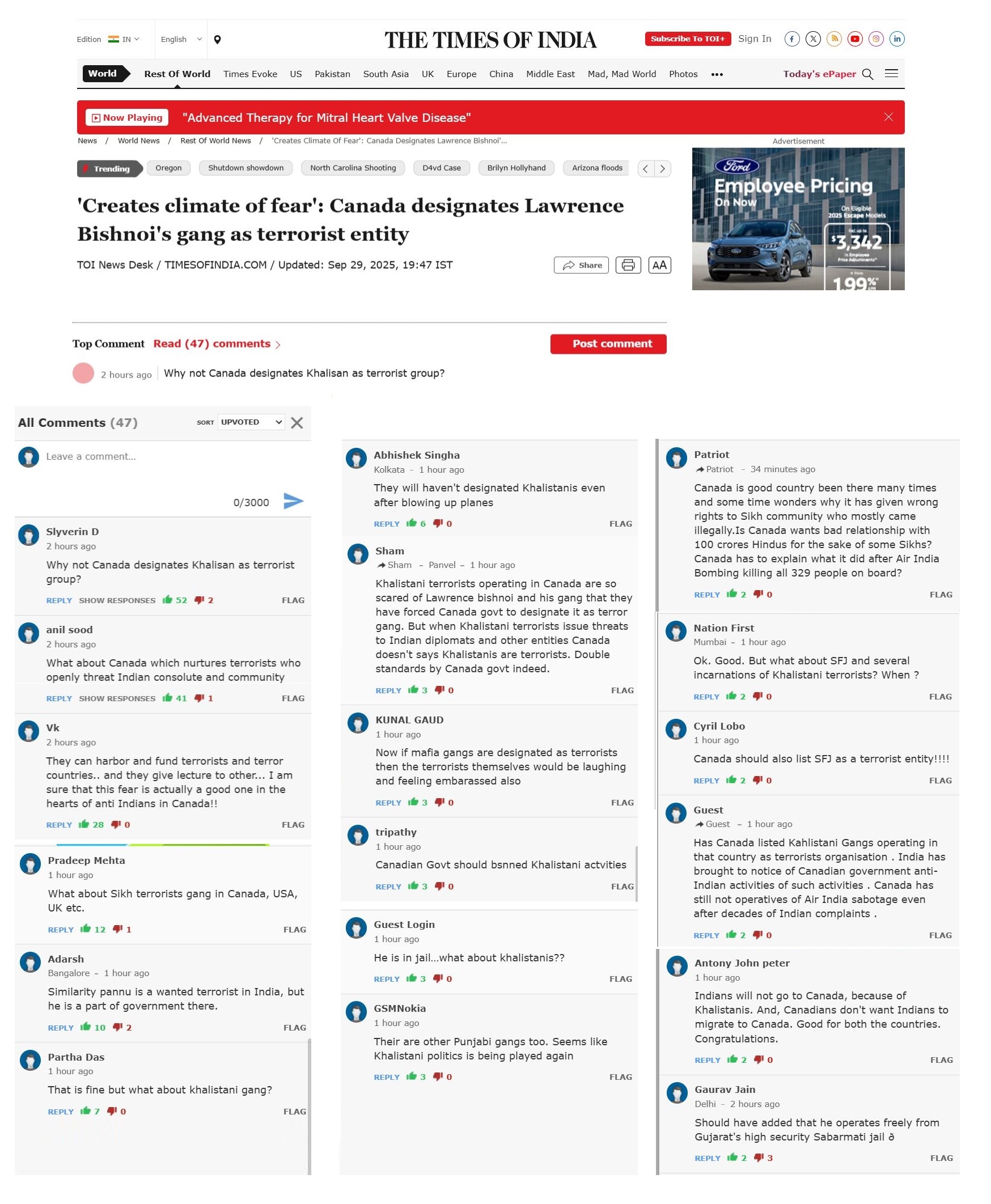
The news spread as far as India, where the media picked it up. Readers’ comments on various articles applauded the Canadian initiative, along with a question: when will the Khalistani gangs be included on the same list, too?
Here below, some of the comments under the article published today by The Times Of India (here the article)