

Federal Budget: not an accounting exercise but an ambition
TORONTO – When it comes to the issues of political value, members of the Press and Media pontificate – a lot; make that always! I do it! Vigilance is part of “the “mandate”, or so I/we justify it. Exercised responsibly, press/media criticism represents a great privilege for those who do so on the public’s behalf. The Political process and its elected players are always a prime target – “low hanging fruit”, so the saying goes.
So, consideration of “the Budget” is primed for latent criticism, which irrespective of any potential merit in [any] government’s spending or investment plan, will always fall short of the target (ours) somewhere in the country. Yet building our “infrastructure” is sine qua non for our survival as an independent political-economic entity.
Therein lies challenge number one: geographically, Canada may pose risks that in other places would outweigh the rewards of “nationhood”. How does the political system keep people connected and focused on common goals from which they may derive “equal/equitable” benefit when distance becomes virtually insurmountable?
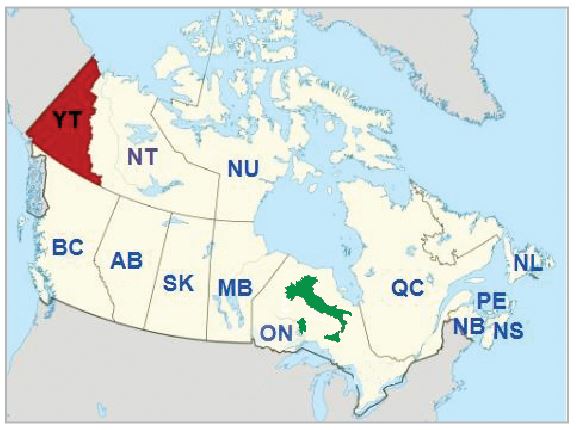
Canada is thirty-three (33) times larger than the landmass of Italy (in the map above, made by us using Wikipedia’s maps). A plane trip from Victoria British Columbia to St. John’s Newfoundland takes longer than a direct flight Toronto-Rome would. A former colleague from the Yukon required twelve hours to connect to Ottawa from his home constituency. How many railroads (freight and passenger), spur rail lines, ports, all-weather pavement highways navigable waterways must we maintain to connect merchandise, natural resources to people does our viability require for productive sustainability?
Equally important, what is in the ground/water that is profitably extracted for the betterment of our citizenry? Grains, minerals, petroleum, natural gas, trees/lumber? Except for “grains” or trees these are finite resources that require people and capital to commercialize. Whom do we keep engaged along the way? The Aboriginal communities, the provincial authorities?
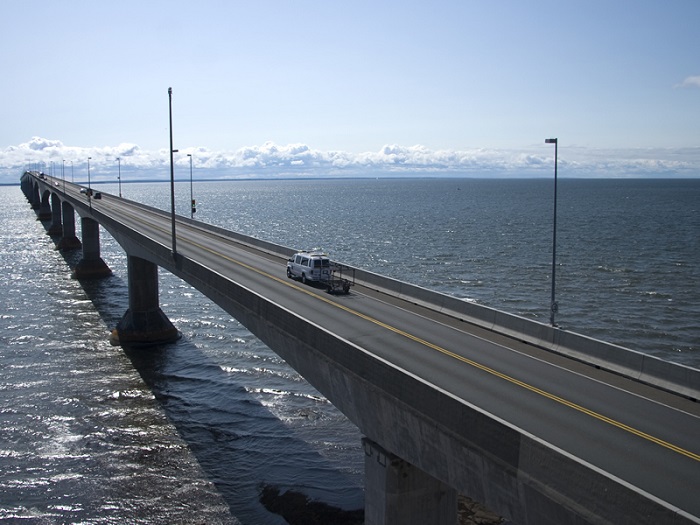
In my lifetime, federal governments have absorbed the majority of investment costs for significant projects like the St. Lawrence Seaway, Maritime ports on the West Coast, Atlantic Coast, ports that require ice-breaking capacities in the Arctic and flights of fancy like the Confederation Bridge connecting Prince Edward Island (population 150,000) to New Brunswick (population 750,000) – in the pic below, from https://www.confederationbridge.com/.
Each of these have been subject of great debate and continue to generate more, just as do the discussions on petroleum and natural gas pipelines. For those who may not be aware, known oil reserves in the Canadian western provinces contain enough product for consumption at today’s rates to last another 100 years.
By all indications, a soon to be underutilized manufacturing sector and scientific/medical research capability will be in the market for financial investments and political will to rediscover the golden eggs of the Canada goose. While we do not know the specifics of the discussions between the Prime Minister Carney and his counterparts around the world, the PM must have considered the value of re-introducing himself as an internationally experienced personality capable of defending “investor interests” for those who might wish to invest in Canada.
Better to have done that prior to the presentation of a Budget which must surely contain the “nuts and bolts” of that reassurance as further cause to support his Budget Plan, that to discuss missed opportunities later.