Tentative deal reached, Air Canada strike ends but the back-to-work law has been dealt a blow
TORONTO – A tentative agreement has been reached between Air Canada and the union representing its flight attendants: the strike ends and the airline’s workforce will gradually return to normal, in seven to ten days.
The two sides overnight with a federal mediator before reaching a tentative agreement that will be presented to over 10,000 members of the Air Canada component of the Canadian Union of Public Employees CUPE). In a statement, the union said the tentative agreement will end the practice of unpaid work by flight attendants when planes are not in flight. It added the agreement also achieves “transformational change for our industry after a historic fight to affirm our charter rights. Your right to vote on your wages was preserved…” the union said in a post on its website announcing the end of the strike, advising members to “fully co-operate with resumption of operations”.
Air Canada said the first flights are scheduled for this evening, but warned that a return to full, regular service could take seven to ten days, as aircraft and crew are out of position. Some flights will continue to be cancelled until the schedule is stabilized. “Only customers with confirmed reservations and whose flights are operational should proceed to the airport” the airline stated. Air Canada said it will offer options to those whose flights were cancelled, including a full refund or credit for future travel. It will also offer customers the option to rebook on other airlines, where possible (for more information and updatings, click here).
As is well known, the federal government intervened in the strike that began last Saturday, invoking Section 107 of the Canadian Labour Code to force the airline and the union into binding arbitration. The Canada Industrial Relations Board then ordered the flight attendants to return to work on Sunday. However, this order was challenged by union representatives, leading the Board to declare on Monday that the strike was illegal. But the flight attendants’ strike continued, with CUPE national president Mark Hancock announcing that the strike would go on regardless. “If it means folks like me going to jail, then so be it. If it means our union being fined, then so be it” he told reporters Monday. “We’re looking for a solution here, our members want a solution here. But that solution has to be found at a bargaining table…”.
At that point, the company convened the union, and the two sides reached an agreement overnight Monday.
But an important precedent has been set: defying a government back-to-work order. The Canadian Labour Congress declared (here the full statement) that Air Canada flight attendants “have delivered a decisive blow to employers who think they can sidestep fair bargaining by hiding behind Section 107 of the Canada Labour Code. The outcome makes one thing clear: Section 107 is no longer a reliable weapon for employers. By refusing to bow to government interference, CUPE flight attendants exposed Section 107 for what it is: an unconstitutional violation of workers’ Charter-protected right to free and fair collective bargaining. Any employer thinking of leaning on Section 107 in the future should think twice—it’s a crutch that just snapped…”. And the Congress concludes: “Section 107 has been dealt a blow it shouldn’t recover from—and that’s good news for every worker in Canada…”.
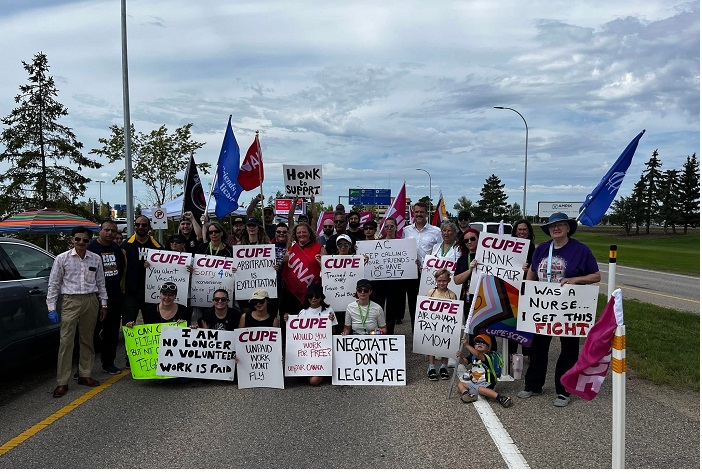
In the pic above, a group of flight attendants during the strike (photo from the Facebook page Air Canada Component of CUPE)