
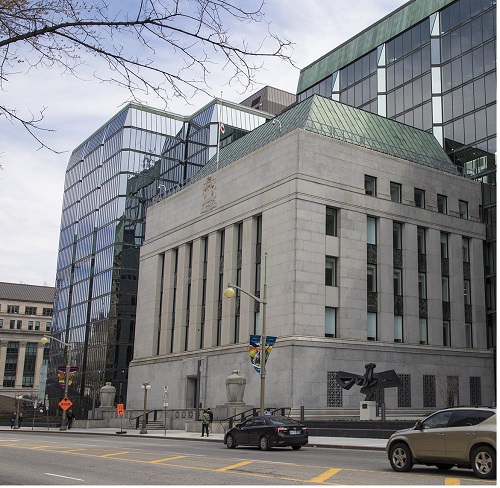
The Bank of Canada holds key interest rate at 2.25% “to support economy”
TORONTO – The Bank of Canada has decided to keep its interest rate stable, leaving it unchanged at 2.25%. Governor Tiff Macklem said today that the policy rate is at the right level to keep the inflation close to 2%, while also supporting the economy in what he called a period of “structural adjustment”.
“We agreed that a policy rate at the lower end of the neutral range was appropriate to provide some support for the economy as it works through this structural transition while keeping inflationary pressures contained” Macklem said.
The move was widely expected by private sector economists, who believe the central bank will maintain the current policy rate through the first few months of 2026. However, if the economic outlook were to change, “we stand ready to react” Macklem said.
But what will the Canadian economy look like next year?
One of the main factors causing global uncertainty is US trade protectionism. The unpredictability of US trade policy and the renegotiations of the CUSMA, says the Bank of Canada, are creating uncertainty about how the economy will adapt to the tariff increases and the underlying economic dynamics. The central bank’s primary goal is to keep inflation around 2%: currently, inflation is progressing as expected, with the consumer price index at 2.2% in October. Although consumer price inflation is expected to remain close to the 2% target next year, the Bank of Canada expects some “instability” in the short term, as inflation will be “temporarily” pushed higher. The data will be compared with those from the previous holiday season, when the federal government instituted a temporary suspension of the GST/HST.
Today’s decision to leave the rate unchanged comes about a month after Prime Minister Mark Carney presented his first budget, which pledged to spend $280 billion over five years on capital investments in new infrastructure, productivity and competitiveness measures, defense and security, and housing. The budget brought Canada’s deficit to $78.3 billion.
Macklem said he expects increased government spending and public and private investment to contribute to growth in both supply and demand in the economy. The full impact, however, will take time to be fully felt.
The central bank governor sees investment as a good driver. “We need to improve our productivity, invest more, diversify our trade. This is what will increase our income, and with higher income, everything will become more affordable” he concluded.
The next rate decision is scheduled for January 28, 2026.
Photo: www.bankofcanada.ca