
Wildfires: 52,000 displaced this season amidst a thousand difficulties
TORONTO – The fire emergency is nearing its end, with “only” 18 fires still out of control (data collected today by the Canadian Interagency Forest Fire Center, CIFFC – here), and the first assessments are being made. One is from the Canadian Red Cross, which over the summer recorded 52,000 people displaced across the Prairies, Ontario and Atlantic Canada, making it the agency’s largest domestic operation in recent memory. This veritable exodus has necessitated mobilization, often difficult especially because this year the fires started early, catching everyone unprepared.
In Manitoba, where approximately 32,000 people fled their homes, the fires began in early spring and continued to rage throughout much of the summer: Snow Lake, a town of 1,000, was evacuated twice. Also in Manitoba, according to Flin Flon Mayor, George Fontaine, whose community of 5,000 was evacuated for four weeks starting in late May, a key lesson is that firefighting teams need to be prepared to tackle wildfires earlier than usual. “You no longer can just wait for, for example, until the May long weekend to equip (wildfire crews). Nature’s not waiting and we can’t” Fontaine said, according to The Canadian Press.
Further fires also require more resources, Fontaine said: when the flames broke out near Flin Flon, in the northwest of the province, firefighting aircraft were already battling blazes in Whiteshell Provincial Park, in the southeast.
Then there’s the problem of transporting evacuees from often remote areas. In the case of Flin Flon, for example, “we had to commandeer school buses and find volunteers to drive them” Fontaine said. The buses managed to make the ninety-minute journey, dropping off people waiting to depart further south, and returning to Flin Flon to pick up others. The situation was even more complicated in the Cree community of Pimicikamak, where several thousand people were airlifted on five-hundred-kilometer flights south to Winnipeg. Additionally, thick smoke blocked the local airport, so people were transferred 40 kilometers away to Norway House: the journey also included a ferry ride… “It took 12 hours to get people through to Norway House” said Pimicikamak Chief David Monias. It took a week to get everyone out of the area, and the evacuation lasted about a month, starting in early July.
And then there were further problems finding accommodations for all the evacuees: there wasn’t enough room in the hotels, despite efforts made in Winnipeg, Brandon, and as far away as Niagara Falls to accommodate them.
There are, therefore, many “collateral effects” of the fires: not just smoke and air quality. There’s a lot of work to do ahead of next year.
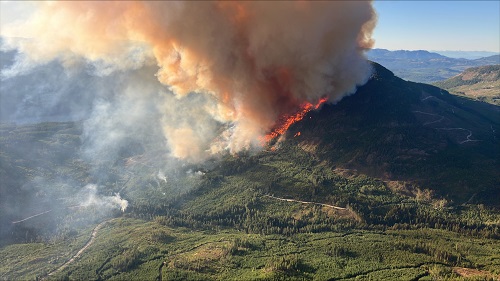
In the pic above, a wildfire in British Columbia in August (pic from Twitter X – @BCGovFireInfo)