
Wildfires, smoke and cold: Environment Canada issues frost and air quality advisories
TORONTO – Summer is practically over, but wildfires are not. And while Western Canada continues to face emergencies due to smoke and air quality, the first frost warnings are arriving in Eastern Canada.
Environment Canada has issued air quality advisories in numerous regions of British Columbia, Alberta, Saskatchewan, and the Northwest Territories, as well as frost warnings in parts of Ontario, Quebec, and New Brunswick. But let’s start with the fires. Rabid wildfires continue to trigger air quality advisories across large swathes of Western Canada: the most affected areas are the Central Okanagan and Kootenay Lake in British Columbia, Lethbridge and High Level in Alberta, Buffalo Narrows and Beauval in Saskatchewan, and Fort Simpson in the Northwest Territories. Residents of affected communities are urged to stay indoors and keep windows and doors closed as much as possible.
“During a wildfire, smoke conditions can change rapidly over short distances and vary considerably from hour to hour…” Environment Canada warns. “Limit time spent outdoors. Consider reducing or rescheduling outdoor sports, activities, and events” …an air quality advisory is also in effect for Annapolis County, Nova Scotia, where crews are working to contain a wildfire.
There are numerous wildfires still burning across the country: 627, according to real-time data from the Canadian Interagency Forest Fire Centre. Almost all of the fires are in Western Canada, and 122 of them are still out of control (online updates here: https://www.ciffc.ca/).
Meanwhile, the autumn weather that has recently arrived in eastern Canada has brought frost warnings to parts of Ontario, Quebec, and New Brunswick. The frost warning for Ontario, issued today, covers much of the province, in and around Algonquin Provincial Park and rural communities such as Bancroft, Haliburton, and Huntsville. Frost has also been announced in parts of Quebec and New Brunswick, including parts of the Gaspé Peninsula and communities such as Campbellton, Grand Falls, and Woodstock.
Due to frost, Environment Canada recommends that people in affected areas take protective measures to protect frost-sensitive plants and trees, such as adequately covering them. “Frost warnings are issued when temperatures are expected to reach freezing during the growing season, potentially damaging and destroying plants and crops,” explains Environment Canada. Real-time updates for both smoke and frost warnings are available at https://weather.gc.ca
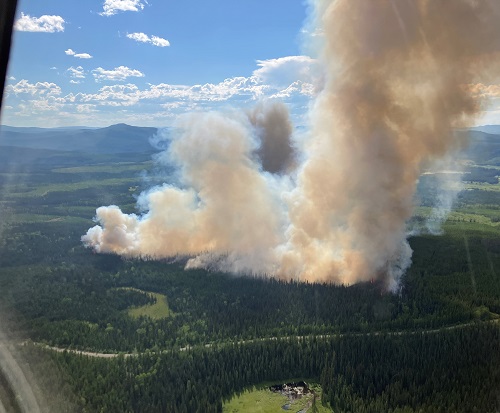
In the pic above, a wildfire in British Columbia (from Twitter X – @BCGovFireInfo)