VICTORIA — British Columbia continues to battle one of the worst wildfire emergencies in recent years. Provincial authorities describe the situation as “explosive and extremely dangerous,” as Cliff Chapman, director of wildfire operations for the B.C. Wildfire Service, has warned on CBC (here), while the return of extreme heat, dry conditions and the risk of lightning threatens to further intensify the numerous fires still burning across the province.
According to the B.C. Wildfire Service’s real-time update (here), at the time of writing this article there are currently 115 active wildfires across the province, with about half classified as out of control.
The largest blaze is the Pear Lake wildfire, which has already consumed approximately 1,247 square kilometres of land, making it the biggest fire burning in British Columbia this season. According to the Thompson-Nicola Regional District, the Pear Lake fire has damaged at least 120 properties — a figure that does not yet include the Village of Clinton, one of the hardest-hit areas. Officials warn that the toll could rise as emergency crews gain safe access to additional areas devastated by the flames.
Another devastating front is the Bradley Creek wildfire, west of Vernon, where Okanagan Indian Band Chief Dan Wilson estimates that at least 200 homes have been destroyed. The figure remains preliminary, but the scale of the destruction has already been described as one of the worst disasters in the community’s history, with many residents losing everything they owned.
The Bradley Creek fire has grown to approximately 28.5 square kilometres and, together with the nearby Quilpituk Creek wildfire, has forced thousands of residents to flee their homes.
Across British Columbia, about 8,000 people are currently under evacuation order, while another 7,100 residents are under evacuation alert and have been told to be ready to leave at a moment’s notice.
In the Central Okanagan, the emergency is centred around the threat posed by the Quilpituk Creek wildfire. A total of 2,223 properties remain under evacuation order, while another 425 properties are under alert. The Regional District of North Okanagan also expanded evacuation zones on Tuesday, adding dozens of additional properties.
Authorities have extended safety measures to include the Okanagan Indian Band, while some evacuation areas in Spallumcheen have been reduced following improvements on the Bradley Creek fire.
Meanwhile, weather conditions are worsening. The B.C. Wildfire Service has warned that hotter and drier conditions have returned and are expected to increase fire activity in the coming days.
In the southern Interior of the province, temperatures are expected to reach around 35 C, with the possibility of dry lightning — a particularly dangerous threat because it can spark new fires without enough rainfall to slow their spread.
Adding to the challenge are powerful winds. Over the weekend, crews battling the Bradley Creek fire faced winds of up to 80 kilometres per hour, with gusts reaching 115 kilometres per hour at higher elevations.
The wildfires are also creating major transportation problems, with several key routes closed across the province. Public services have also been affected: in the East Kootenay region, wildfires have left nearly 18,000 BC Hydro customers without power.
With more than 15,000 people affected by evacuation orders and alerts, hundreds of homes destroyed and thousands of square kilometres already burned, British Columbia is bracing for more difficult days ahead.
And the crisis extends far beyond B.C.: across Canada, nearly 700 wildfires remain active (real time updating: CIFFC), keeping much of the country in the grip of another intense wildfire season.
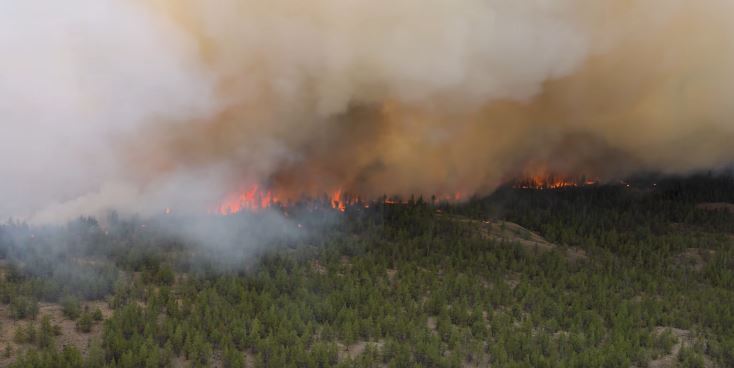
In the pic above, one of the wildfires in British Columbia (screenshot from a video released by the B.C. Wildfire Service and published on its official Facebook page).