
Air quality is improving in Toronto, but the emergency is not over
TORONTO – The air quality alert for the Greater Toronto Area has been lifted after being in effect over the long weekend. As can be seen from the real-time data on Environment Canada’s website (here), the situation — while we write, at 1.30 pm of August 5, 2025 — has improved somewhat, and the AQHI (Air Quality Health Index) has risen in the last few hours from 6 (moderate risk) to 5, 4, and then 3 (low risk) at 11 a.m. this morning.
According to forecasts, the AQHI is expected to hover around 4 (moderate risk) tomorrow: it’s a level that, however, is not high enough to warrant issuing an alert, as Alexandra Cournoyer, Environment Canada’s maritime operations supervisor, told the CBC (here). However, the situation could worsen again in the coming days, again due to smoke from the wildfires raging across much of Canada. “there could be periods of time that it gets better, but that there could also be periods of time later this week that it it’s coming back…” Cournoyer added. In short, the emergency is not over, being closely linked to another emergency: the fire emergency, which unfortunately generally lasts throughout the summer.
Meanwhile, thanks to today’s improvement, Toronto has dropped out of the top ten in the IQAir Swiss air quality monitoring ranking, which is conducted in real time and can be found at www.iqair.com/ca/world-air-quality-ranking …as of 12:45 p.m. today, Toronto was 39th, and Montreal was 105th, despite also being in the top ten until yesterday.
A little help to further improve the situation could come from bad weather: rain is forecast for the weekend, which will contribute to improving air quality, as Lucas Alexopoulos, operational meteorologist for Environment Canada, told the CBC.
In any case, the advice remains the same: in the event of an Environment Canada alert, it’s best to stay indoors if possible, and this is especially true for vulnerable people, such as those with respiratory conditions or pregnant women, as well as the elderly and children. It’s best to reduce your time outdoors, keep doors and windows closed, and follow local guidelines.
Another piece of advice experts have repeatedly emphasized on these occasions is to use a good-quality air filter in ventilation systems or a portable air purifier to protect indoor air from smoke. When smoke is in the air, it’s easy to notice: irritation of the eyes, nose, and throat, headache, and a mild cough can occur. Sometimes, other symptoms may also appear, such as wheezing, chest pain, or a severe cough.
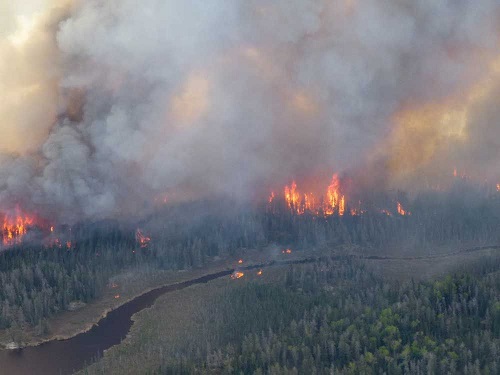
In the pic above, a wildfire in Manitoba (photo: Government of Manitoba)