GAZA (Palestine) – The devastation of Gaza is reflected in the words of Cardinal Pierbattista Pizzaballa, who met with journalists the day after his visit to the Strip (here our previous article with photos and video). It was the first trip by the Latin Patriarch of Jerusalem since the ceasefire came into effect—though he had already been there several times in recent months—undertaken to bring closeness and comfort to a population exhausted by more than two years of war, and to bear witness, through his presence, to the solidarity of the entire Church.
The picture that emerges – as reported by many media outlets, as Vatican News – is bleak: 80 percent of the infrastructure has been destroyed, while what remains standing is often unsafe or no longer habitable. Yet even amid the rubble, some families have found the strength to return to their homes. Around four hundred people are still living within the compound of the Holy Family parish, led by Father Gabriel Romanelli; the majority, however, survive in makeshift tents. “It is cold” the Cardinal recounted. “I felt it myself. Think of the children…”.
Children are precisely the most fragile—and at the same time the brightest—face of Gaza. Despite everything, Pizzaballa says he sensed “a desire to return to life.” The streets are marked by the silence of shuttered shops and economic paralysis, but here and there small stalls have appeared under tents, selling fruit and vegetables: minimal yet stubborn signs of normality.
“The worst hunger is behind us” the Patriarch explained, while stressing that for many food remains a mirage. With no work and no income, the population depends almost entirely on humanitarian aid which, thanks to the efforts of international organizations, is finally reaching the territory. The economy is at a standstill; the situation is “catastrophic” Pizzaballa admits. And yet, even in this scenario, a desire to rise again and to celebrate Christmas is emerging. A celebration that speaks first and foremost to children, and that brings attention back to their future. “I was struck by the number of children in the streets” he said. “They should be in school.” Bringing them back into classrooms is one of the priorities of the Latin Patriarchate. The Cardinal describes the children’s enthusiasm as a true revelation: “Full of joy, full of life.” In that vitality, he sees a hope capable of going beyond the ruins: “They will be the ones to save our communities.”
Yet the weight of unanswered questions remains. When will reconstruction be able to begin? “The war has stopped, but the conflict has not,” he observes bitterly. Tensions run throughout the entire region, from the Strip to the West Bank, making it difficult even to utter the word “hope.” And yet, precisely during the Christmas season, the Patriarch insists, it is necessary to do so, because the memory of Christ’s birth— which took place in an equally complex context—becomes a call to commitment.
“We must remain Church” Pizzaballa concludes, assuring continued commitment to restoring stability to Gaza and to being the voice “of all the poor and of those who suffer because of war.”
And tomorrow, Christmas Eve, Pizzaballa himself will celebrate Midnight Mass in Bethlehem: Palestinian President Abu Mazen is also expected. Right there, near the “Grotta” of the Nativity, where Jesus was born—the bearer of peace.
In the pic above, Cardinal Pierbattista Pizzaballa (photo by Latin Patriarchate of Jerusalem – https://lpj.org/) during the press conference; here below is the Christmas message from the Cardinal
Mass for Peace around the world at the Italian Embassy in Baghdad
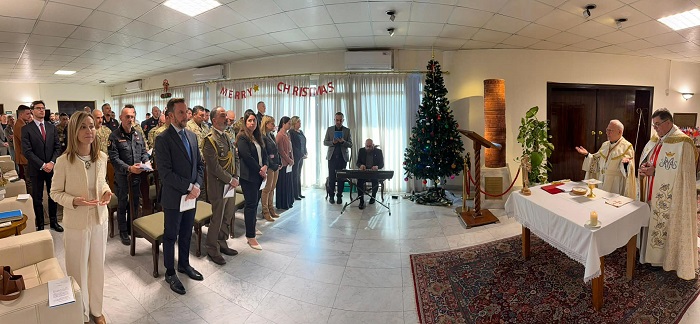
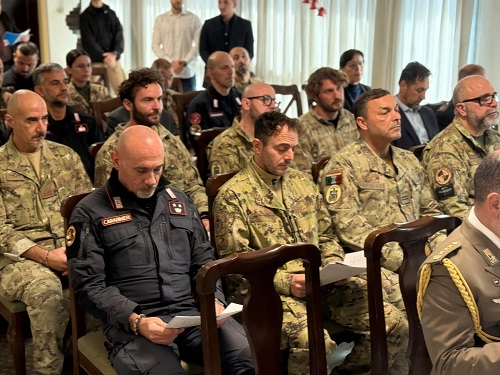
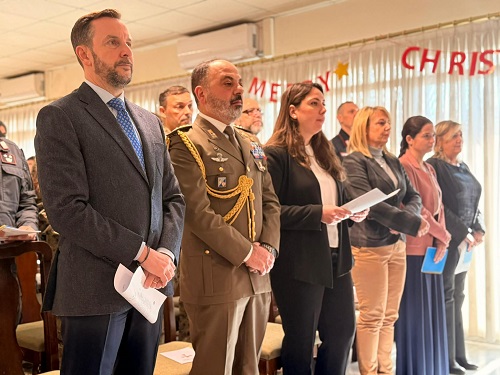
BAGHDAD – A Mass for Peace throughout the world was celebrated on Sunday by Patriarch Cardinal Louis Raphael Sako at the Italian Embassy in Baghdad (Iraq), assisted by Bishop Basilios Yaldo, in the presence of the Italian Ambassador Nicola Fontana (together with the entire embassy staff), the Spanish Ambassador Aliza del Pulgar, and a significant representation of all Italian military contingents in Iraq: the anti-Daesh mission (OIR), the NATO Mission in Iraq (NMI), and the EU Advisory Mission (EUAM). In his homily, the Patriarch called for prayers for peace throughout the world, especially in the Middle East, and that “this feast may be a blessing for all and a wish for peace for the year 2026,” as reported by the bulletin of the Chaldean Patriarchate (www.chaldeanpatriarchate.com), from which the photographs published below are also taken.