
 The last few months have been prolific in losses: loved ones killed by Covid-19, jobs and confinement. But there have also been some winners: certain technology companies, medical providers, and of course the drug cartels.
Gangs in Mexico and almost all of Latin America have taken advantage of the crisis to exert influence in their territories, distributing aid and enforcing curfews. And they continue to grow their influence in the markets of Canada and the United States, where their main clients are located, says journalist Marco Antonio Grajales.
This week, Toronto police announced the dismantling of a criminal organization linked to the Jalisco Nueva Generación Cartel, which brought more than a ton of narcotics from Mexico to Canada. It is the largest drug seizure in the history of the city.
In less than a decade, the Jalisco Nueva Generación Cartel (CJNG) has gained a presence in almost half of Mexico and has become one of the most prolific and violent drug trafficking organizations in the world.
The Mexican cartels cause immense suffering throughout the country. They have left mass graves and missing persons in their wake, but they present themselves as benevolent sponsors who pave streets and distribute pantries and anti-Covid gel to the poorest Mexicans struggling to survive the economic crisis caused by the pandemic. Their strength and influence have allowed them to achieve alliances with capos in the main cities of the north of the continent.

Pantries, masks and anti-Covid del Chapo gel
Project Brisa, Toronto’s largest drug seizure
Investigators say the investigation, called Project Brisa, focused on an international drug smuggling ring that transported more than 1,000 kilograms of drugs, including cocaine, methamphetamine and marijuana, between Mexico, California and Canada, using articulated trucks or modified trailers with hidden compartments.
In a press release, the police investigators affirm that the shipment of the drug was possible thanks to the installation of hydraulic mechanisms in the trailers of the articulated trucks, which allowed to smuggle up to 100 kilos of drugs in a single trip. Not even X-ray scanners were able to penetrate these compartments.
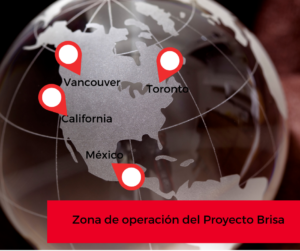
Map of the drug smuggling network, with data from the Toronto police
Strong charges for those involved in the Brisa Project
Criminal lawyer Abdullah Basurto explains that the fact that the police have given it the title of ‘project’ means that the Capture of this group was the result of long police monitoring.
“Police have reported that the 20 people captured face a cumulative total of 183 criminal charges. Each individual must be facing multiple charges of possession of drugs for trafficking, drug trafficking, importation of drugs, intent to commit indictable crimes. Each individual, if found guilty, faces a minimum sentence of two years for each charge for which they are accused and a maximum sentence of life in prison ”, adds Basurto.
In the coming days, the people who were arrested will be appearing in front of a judge to determine their possibility of being released on bail. It is very likely that the prosecution will use the argument of the force of the case against the defendants to prevent their release on bail.
The criminal lawyer adds that “in these types of cases it is more likely that the defendants’ defenses are based on the ability of the police to directly link them to drugs, or violations of rights under the constitution if one took place. Otherwise the lawyers will try to negotiate a sentence ”.
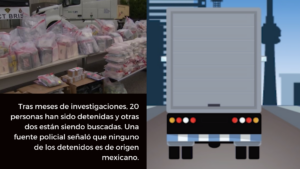
Mexico-Canada Connection
From a small group of deserters from the now defunct Millennium Cartel, the Jalisco Nueva Generación Cartel evolved to form a vast criminal network whose links extend to all of America, as well as Europe and Asia. The key to its rapid incursion has been the strategic presence of operators on the southwestern border of the United States, adjacent to Tijuana, and on the northwestern border, adjacent to Vancouver, in Canada.
Through the use of violence and alliances with local criminal groups, they have displaced historically dominant cartels – such as the Sinaloa and Beltrán Leyva cartels – in key drug trafficking points on the Pacific Ocean coast, Grajales says.
Reports from US security agencies reveal that the CJNG distributes cocaine and methamphetamine along 10 thousand kilometers of coastline of that ocean, in an area that extends from the Southern Cone to the border of the United States and Canada.
In addition to the maritime routes of British Columbia, Grajales claims that cocaine is also trafficked overland through the United States. “The border between the United States and Canada is the largest least defended border in the world,” he says. “It is very easy to cross illegally. If you wanted to bring cocaine to Canada from Mexico – assuming you already know how to get it to the United States – it’s really not difficult, ”he adds.
Two years ago, Canadian police announced the seizure of 180 kilograms of methamphetamine that was hidden in cars made in Mexico.
Rick Barnum, then Commissioner of Investigation and Organized Crime of the Ontario Provincial Police, recalled that methamphetamine has become one of the main health problems for Canada.
According to a report by the Canadian Center on Substance Use and Dependency, charges for methamphetamine possession increased by 590% between 2010 and 2020.
Drug use is growing
Health professionals say stress, loneliness and economic difficulties have exacerbated drug use. “Stay-at-home orders have isolated people struggling to stay sober and have diminished access to treatment and opportunities to distract themselves from addictions,” say Marcelina Jasmine Silva and Zakary Kelly, in the American Journal of Managed. Care.
Canada’s public health agency claims the Covid-19 pandemic sparked an increasingly deadly overdose crisis that continues to claim lives and corrode communities. The agency’s grim figures show 6,214 people suffered opioid-related deaths in 2020.