

TORONTO – Crime is shifting from urban areas to rural ones, where the most serious offences are increasingly being committed year after year. This is according to the crime report released Tuesday by Statistics Canada, titled “Police-reported crime in rural and urban areas in the Canadian provinces, 2024.”
While most Criminal Code offences (excluding traffic violations) still occur in urban areas, StatCan’s report shows that 19% of crimes in 2024 were recorded in rural areas, even though these regions account for only 14% of the provincial population.
Looking more closely, the report finds that the crime rate in rural areas was 42% higher than in urban areas in 2024, with 7,421 incidents per 100,000 population compared to 5,235 per 100.000 in cities. The increase has also been steady in recent years: the rural crime rate rose from 7,386 incidents per 100,000 population in 2023 to 7,421 in 2024, marking the fourth consecutive annual increase, while the urban crime rate fell from 5,474 to 5,235 over the same period.
The rural surge also concerns the severity of crimes. To measure this, StatCan uses the Crime Severity Index (CSI), which is based on incarceration rates and the average length of prison sentences for violent offences. In 2009, the first year with comparable data, the violent CSI was lower in rural areas (84.5) than in urban areas (95.3). Fifteen years later, the situation has reversed: in 2024, the violent CSI was 46% higher in rural areas (134.8) than in urban areas (92.5).
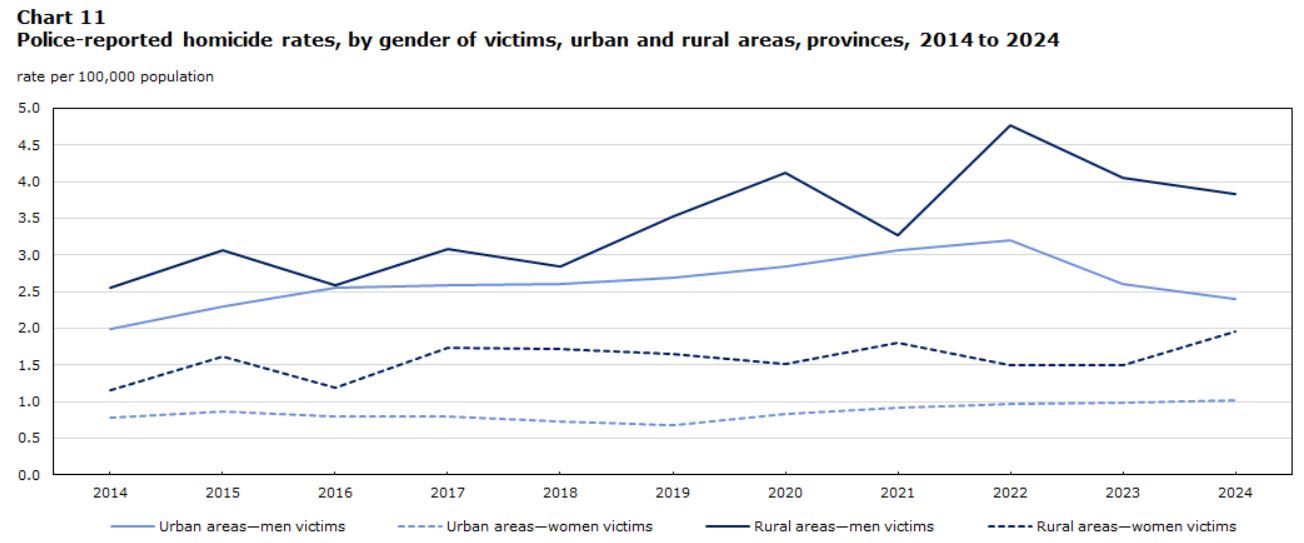
Focusing on homicide, the most serious offence, rural areas have also seen an upward trend. The rate rose from 1.86 homicides per 100,000 population in 2014 to 2.92 in 2024, an increase of 57%. In 2024, police reported 173 homicides in rural areas, compared with 605 in urban areas, with rates of 2.92 and 1.72 per 100,000 population, respectively.
The increase was more pronounced among women than men. From 2014 to 2024, the homicide rate involving female victims in rural areas rose by 68% (from 1.16 to 1.96 per 100,000 women), compared with a 50% increase for men (from 2.55 to 3.83 per 100,000 men) – see the charts below, from the report. In 2024, women accounted for 57 of the 173 homicide victims in rural areas, the highest figure since comparable data were first collected in 2009.
Assault is the most frequently reported violent crime by police in both rural and urban areas, although rates are higher in rural regions. Sexual assaults are also increasing: between 2014 and 2024, the rate rose by 56% in rural areas (from 79 to 124 per 100,000 population) and by 55% in urban areas (from 53 to 82). Alongside this, intimate partner violence is also rising: in 2024, rural communities recorded 573 incidents per 100,000 population, nearly double the urban rate of 310.
Finally, StatCan notes that rural crime was historically concentrated in the Prairie provinces and, to a lesser extent, Newfoundland and Labrador. Today, however, crime has increased in rural areas across nearly all Canadian provinces.
The full report by Statistics Canada is here: Police-reported crime in rural and urban areas in the Canadian provinces, 2024
Photo by Gerd Altmann from Pixabay