
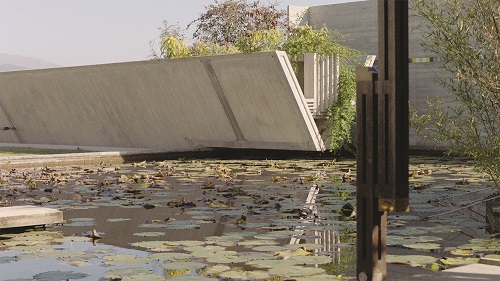
TORONTO – Stefano Croci and Silvia Siberini’s “challenging” and intriguing documentary The Pavilion on the Water recently screened at the ADFF (Architecture & Design Film Festival), hosted by TIFF Lightbox near Toronto’s Entertainment District. The documentary, about Venetian Architect Carlo Scarpa, was almost entirely attended by professors and students of architecture and [of course] bonafide working architects, confirmed by a show of hands in the preamble to the screening.
Whether this was the result of targeted marketing or limited interest, the film undoubtedly deserves broader exposure beyond the [sometimes]insular gaze of the Architect community. A community whose best and brightest, especially, deserve more spotlight than is often received, and more importantly have much knowledge to impart in areas spanning from design to engineering and almost everything in between.
The film strikes an experimental chord with its eerie and continuous tri-note piano track, which intentionally or not straddles a line between contemplative soundscape and horror movie theme music. But as co-Director Stefano Croci explains, “We wanted to bring the public into a meditative state, to understand Scarpa’s spaces”. Judging by the audience’s negative decibel atmosphere, I’d say that was achieved.
The film focuses on Scarpa’s Brion Sanctuary at San Vito d’Altivole, near Treviso, on which he designed and built a burial ground for the Brion family. The Brion Sanctuary is considered a masterpiece of modern architecture, inspired by Scarpa’s appreciation of Japanese design concepts, philosophies and overall culture – noted by a large stockpile of the “Japan Design House” magazine in his Archive.
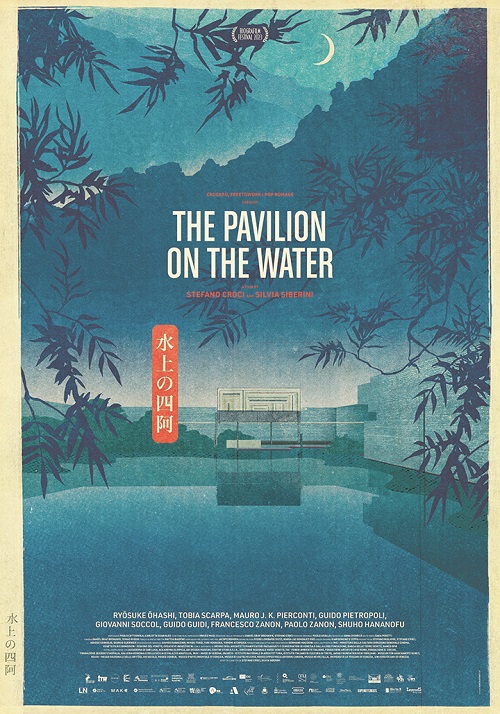
The film does not go into any real depth about Scarpa’s life and career, however, and intentionally avoids being an expository on his life. Rather, as Croci states, “Ours is a film about his teaching on what it means to make a work of art”. The filmmakers assume its audience knows who Carlo Scarpa is, but more importantly, if you don’t, the experience of watching a film that photographs a masterpiece inevitably acts as an inspiration.
The filmmakers have adopted what Heraclitus says of the oracles at Delphi, “The God at Delphi neither reveals nor conceals, but gives a sign”. In other words, one must be proactive in pursuit of a truth. In this case, The Pavilion on the Water acts like the alluring voice of a Siren, calling its audience to do their own exploration of Scarpa’s artistry – beyond the end credits.
Aside from the meticulously executed cinematography, referred to as an “obligation” of any Architect’s Photographer, the film’s few talking heads – including Scarpa’s son, Tobia, who famously designed the Benetton Stores – capture the poetry of his work through their personal stories and reflections. One former colleague even declares, “We see his work as you could hear a Beethoven sonata
There is no longer an artistic sensibility to do what he did. He was interested in penetrating the spirit of the materials”. To that point, the film begins with a lengthy narration, by and over, Tobia Scarpa’s sharpening of his pencil with a small blade and acute concentration. “My father always taught his students how to sharpen pencils because it’s what you would do before starting work”, explains Tobia while lamenting the lost art.
The scene lasts for longer than what most people’s attention span can endure – but for this viewer, learning how to manually sharpen a pencil from an 89-year-old Master of Design and Architecture, is itself worth the price of admission.
Images courtesy of Caucaso Societa Cooperativa & Pop Homage

Massimo Volpe is a filmmaker and freelance writer from Toronto: he writes reviews of Italian films/content on Netflix