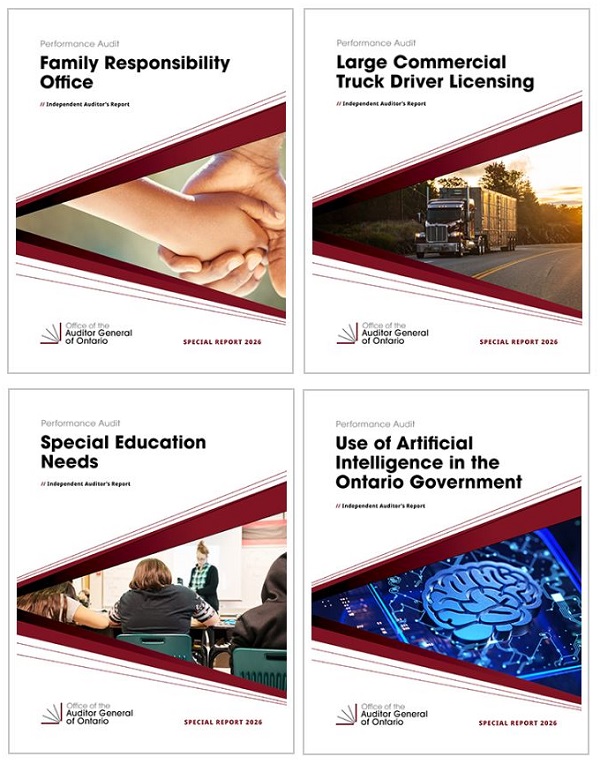
TORONTO – There are many problems in the services that the Government of Ontario provides to the province’s residents, across various sectors ranging from education (where the most serious shortcomings are emerging) to families, and including transportation. This was stated not by the opposition, but by Auditor General Shelley Spence, who today released four special reports: “Family Responsibility Office (FRO)”; “Large Commercial Truck Driver Licensing”; “Special Education Needs”; and “Use of Artificial Intelligence in the Ontario Government.”
The first report examines how effectively the FRO (which enforces court orders related to child and spousal support in cases of separation and divorce) ensures compliance with support orders, accurately records and distributes court-ordered payments, uses its human resources, and applies enforcement measures on behalf of the more than 116,000 families in this situation in Ontario. The audit found that families waited an average of eight and a half months for a court order to be registered and to receive their first payment through the FRO (22% waited more than a year), and that as of March 31, 2025, payors owed recipients with active cases nearly $2.1 billion.
The second report, concerning licences for driving large commercial trucks, assessed whether Ontario’s systems provide adequate oversight of training, testing, and licensing. The answer was “no.” The audit identified several weaknesses: the Ministry of Colleges and Universities had never inspected 25% of registered private colleges that were actively offering Entry Level Training (ELT); some students at registered private colleges obtained ELT without completing all mandatory training hours and requirements; and the Ministry of Transportation did not prevent drivers with prior infractions from obtaining a licence.
The third report concerns “special” education, meaning the education of students with various difficulties (like disabilities), whose number in Ontario schools has increased by 7% over the past ten years. This report highlights the most serious concerns. Indeed, the audit found: that many students waited months for specialist assessments, with about one-third (in the schoolboards TCDSB e PDSB, examined by the Auditor General) waiting more than a year before being formally evaluated; that there are no standard criteria and guidelines for identifying and supporting “special needs” students; that Individual Education Plans often lack measurable goals, are not sufficiently individualized, and do not consistently document input from parents or guardians; that educational assistant absences and vacancies were not replaced by qualified staff between 49% and 72% of the time, reducing available support; and that students with special needs were sometimes sent home, or asked to stay home, without schools formally recording the number, documentation, or reasons. In short: a disaster.
The fourth report concerns the use of artificial intelligence (AI) in the Ontario government: how are AI systems being used within the Ontario Public Service (OPS)? Poorly, according to the Auditor General. The report found that OPS staff were accessing unsafe and unsecured AI websites, creating risks of potential unauthorized data exposure (including citizens’ data), and that only 3% of OPS staff completed training on responsible AI use (which was not mandatory). The OPS-approved generative AI tool, which provides a secure data environment, was used in only 6% of cases where staff used generative AI.
In all four reports, the Auditor General provides a series of recommendations to the Government of Ontario – led by Conservative Premier Doug Ford – to ensure that public systems function as intended. “These Special Reports make recommendations for improvements to strengthen oversight, consistency and service delivery in programs that matter to Ontarians,” said AG Shelley Spence (in the pic below, from www.ola.org) when presenting them today. The full reports are available here: https://www.auditor.on.ca/en/content/specialreports/specialreports.html