
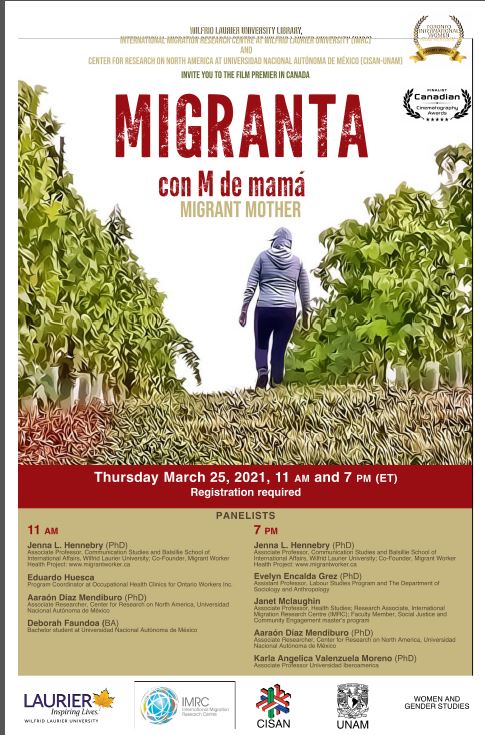
Mexican mothers are leaving their families to travel to Canada to work in the fields. Poverty and a lack of employment opportunities in their home country have caused hundreds of women to migrate to Canada and other high-income countries to work and send money home to help support their families.
In the documentary Migranta con M de Mama (recognized as the best film about women at the Toronto International Women’s Film Festival), Mexican director Aarón Díaz Mendiburo follows the lives of three migrant women from Mexico and reflects the challenges they face, such as family detachment, loneliness, sexism at work and the lack of programs that meet their different needs.
Díaz Mendiburo knows the situation of these women well because, in addition to being a lover of cinema and documentaries, he is a doctor in Anthropology, a teacher in Social Work and a degree in Communication Sciences from the National Autonomous University of Mexico (UNAM) and a researcher at the Research Center on North American Affairs. And in 2018 he completed a postdoctoral stay at the International Migration Research Center of Wilfrid Laurier University, in Canada.
Why do women emigrate?
To explain the phenomenon of migrant women, Díaz Mendiburo comments that migrating to find a dream elsewhere is inherent to the human being. “Although it is a learned behaviour that a very small percentage of the world’s population carries out, it is still painful and often cruel because it has to do with detachments, roots, identity and cultural contexts, as well as places you left”.
To qualify for the Canada Seasonal Farm Worker Program, which is over 50 years old, women must come from rural areas, have experience in the field and must have dependent family members in their home country to ensure that the workers will return home, explains Kerry Preibisch, is a professor in Sociology and co-coordinator of the International Development Studies Program at the University of Guelph.
Despite the precarious nature of these jobs, the opportunity to access Canadian wages is highly valued by migrant women and there is a long queue of applicants, Preibisch explains.
Women represent 42 percent of the 164 million migrant workers worldwide and are responsible for roughly half of the estimated $601 billion in global remittances annually. But for many migrant workers, who are at greater risk of discrimination and gender-based violence, migration often comes at great personal cost.
A study developed by the U of G and AgriFood and Rural assures that “women are often forced to work in poor conditions and live in overcrowded households with many other women. It is not uncommon for them not to seek care for illnesses, injuries or pregnancies, as the competition is high and they fear being fired and sent back to Mexico ”.
If living conditions are difficult, what leads these women to emigrate? For love and the possibility of providing better futures for their children.
The documentary
The Laurier Library, in collaboration with the International Migration Research Center, the Women and Gender Studies Program and the North American Research Center (CISAN) / North America Research Center of the National Autonomous University of Mexico They present on March 25 the documentary Migranta con M de mama, which highlights the voices of migrant workers and documents the experiences of migrant agricultural workers from Mexico to Canada, providing a vision of the complex and challenging challenge of Vicky, Betty and Lety.
After the screenings, the audience can meet the filmmaker and participate in a lively and dynamic question and answer session with human rights defenders and researchers, as well as with migrants who are in Canada and Mexico.
As an independent documentary filmmaker, Aaraón Díaz has directed and produced Migrants: those who come from within (2007), Matices: “temporary” migration in Canada (2011) and Migranta con M de mama (2020).
By Silvia Mendez