VICTORIA – Like Ontario, British Columbia is also battling numerous wildfires. According to the latest real-time data from the Canadian Interagency Forest Fire Centre (CIFFC), nearly 90 wildfires are currently burning across the province, and new evacuation orders have been issued in several areas over the past few hours.
In an effort to contain the advancing flames, the B.C. Wildfire Service has recently deployed a new “weapon,” using it for the first time in Canada in this specific way: drones have been employed to carry out tactical ignitions during an active wildfire. These operations involve deliberately setting small, controlled fires ahead of the wildfire front to remove the vegetation that could fuel the flames. By doing so, firefighters create a burned strip of land that can slow or even stop the fire’s advance.
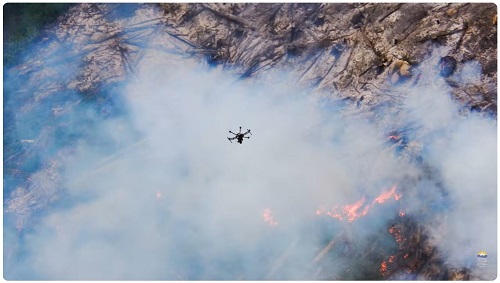
The B.C. Wildfire Service explained that it has been using drones for prescribed burns for several years, thanks to a Plastic Sphere Dispenser (PSD), a device that releases small incendiary spheres at predetermined locations, allowing crews to control the distribution and intensity of the fire without exposing firefighters to hazardous terrain or dangerous conditions. This time, however, the system was used for the first time as part of an active wildfire response – here above is an explanation of the operations, carried out for the first time last weekend.
As the B.C. Wildfire Service wrote on its Facebook page (here below is the original post), “the drone used for ignition is accompanied by observation drones outfitted with infrared and imaging capabilities which gives us project intelligence not just during ignitions but through all phases of operations.” And: “The observation drones can livecast visuals to personnel, providing additional insight and perspective to adjust tactics and manage crew safety… allowing us to see through the smoke to watch for ember transplant, assess ignition effectiveness and monitor fire behaviour.”
The agency also stressed the broader value of the technology: “By evaluating and adopting proven innovations, we can improve firefighter safety, strengthen decision-making and better protect communities and the environment.”
Meanwhile, as mentioned earlier, British Columbia continues to face a severe wildfire emergency. In recent hours, the Squamish-Lillooet Regional District issued a new evacuation order for parts of the South Chilcotin Mountains, while an evacuation alert was also issued for the Texas Creek area, south of Lillooet.
Residents of the village of Clinton, in the province’s southern Interior, have also received evacuation alerts after a wildfire there grew to more than 100 square kilometres. The entire city of Kimberley, in southeastern B.C., remains under evacuation alert because of a nearby wildfire complex, while authorities in Boston Bar have urged the remaining residents to leave the community, now surrounded by the Brunswick Creek Complex fires—one of the province’s most significant active wildfire zones, and the location where the B.C. Wildfire Service first deployed drones for tactical ignition operations.
High temperatures and limited rainfall forecast for the rest of the week are expected to increase the risk of new wildfire starts across British Columbia, where smoky skies are also expected to persist. The situation remains critical in Ontario as well, where all of the major wildfires previously reported continue to burn. Across Canada, meanwhile, there were 892 active wildfires as of today, according to (CIFFC).
The photo at the top was taken from one of the videos below, where B.C. Wildfire Service operators explain how Plastic Sphere Dispensers and drones are used for aerial ignition operations