
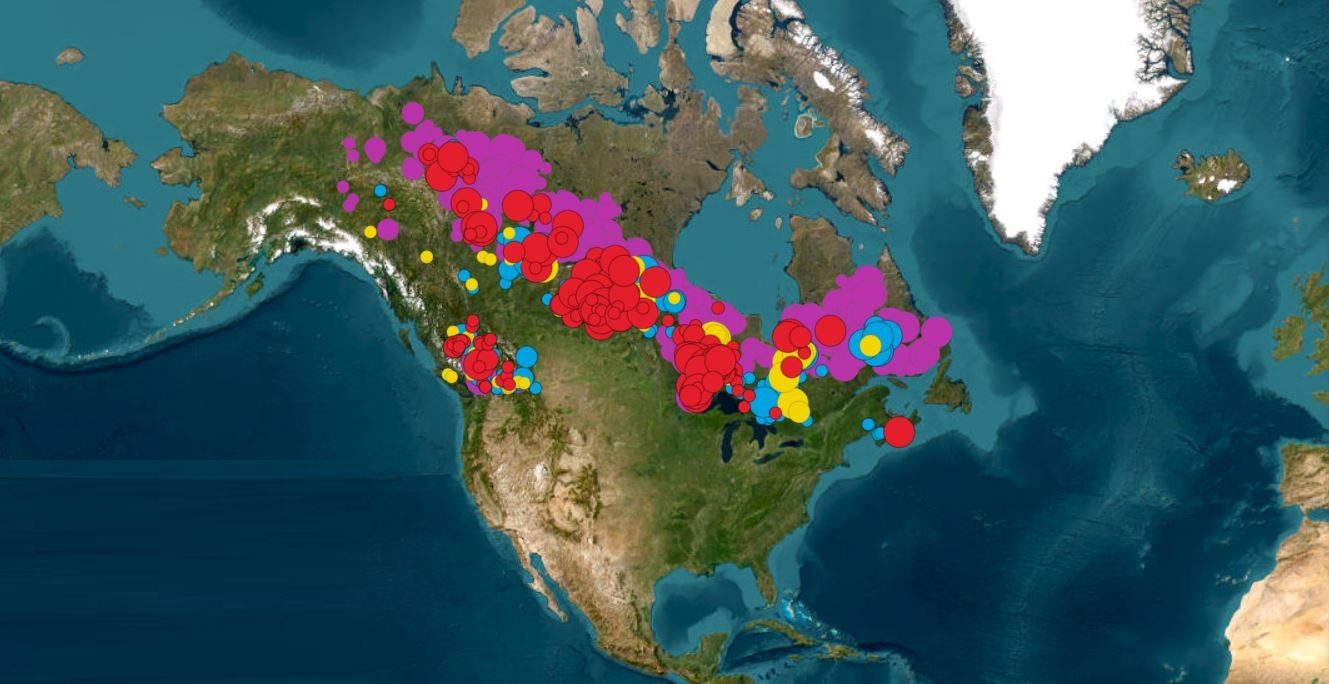
TORONTO – As has become the case every summer, Canada is once again in the grip of wildfires. According to data from the Canadian Wildland Fire Information System and the Canadian Interagency Forest Fire Centre, more than 950 wildfires are currently devastating the country from coast to coast. Of these, more than 230 are out of control.
As seen in Toronto in recent days, one of the consequences of major wildfires is the release of smoke that then spreads into urban areas. In Toronto, conditions have improved since today, and after three days of some of the worst air quality levels in the world, Environment Canada lifted the orange air quality advisory. However, numerous warnings remain in place in other parts of the country, from British Columbia to Quebec, as well as in the Northwest Territories.
Here is the wildfire situation at the time of writing (Sunday afternoon, July 19).
In British Columbia, nearly 112 wildfires are currently burning. According to the BC Wildfire Service, as reported by The Canadian Press / CTV, most were caused by lightning strikes. About two-thirds of the fires are out of control, and most new outbreaks, evacuation orders and alerts are concentrated in the southern Interior of the province. Last Friday, the evacuation of approximately 130 properties near Big Bar Lake and Meadow Lake, in the southern Cariboo region north of Vancouver, was ordered due to a nearby wildfire that was affecting an area of about 40 square kilometres. Numerous air quality advisories have been issued, while more than 500 firefighters have been deployed to battle the flames.
In northern Manitoba, several wildfires remain out of control. One of them forced approximately 600 people from the remote O-Pipon-Na-Piwin Cree Nation community to evacuate. The fire covered an area of 172 square kilometres. Several air quality warnings have also been issued there, with a total of around 150 active wildfires currently burning in the province.
In the Northwest Territories, wildfires forced approximately 1,300 residents of Fort Simpson and 130 residents of Wrigley to leave their communities at the end of June. The evacuees have not yet returned, and many are currently staying in Yellowknife, as the two major fires are still burning, along with roughly 200 other active wildfires across the territory.
In Nova Scotia, firefighting crews are battling an out-of-control wildfire northeast of Halifax, along Mooseland Road, which has grown to nearly 14 square kilometres in size. Last Thursday, an evacuation order was issued for part of the area, affecting between 100 and 150 people.
In Saskatchewan, around 60 wildfires are currently active. The numbers are much lower in Yukon (22), Alberta (15), Newfoundland and Labrador (11), and New Brunswick (2), while Quebec has more than 160 active fires and Ontario nearly 200. In Ontario, the wildfires have already devastated a larger area than all the fires recorded last year combined. And it is only July.
Amid the emergency, Ontario Premier Doug Ford visited Thunder Bay yesterday: the city is the main reception centre for evacuees fleeing the wildfires that are devastating the northern part of the province. Ford urged residents not to return to evacuated areas in order to avoid hindering firefighting operations.
While the province says it is providing accommodation, assistance and deploying personnel and equipment to deal with the nearly 200 active fires, criticism is mounting over the handling of the emergency, both because some believe the resources allocated to fighting the fires are insufficient and because of the evacuation of some First Nations communities: members of Whitesand and Namaygoosisagagun were forced to save themselves by fleeing the flames aboard boats – as reported by The Canadian Press / CP24.
Meanwhile, wildfire smoke has also reached the United States, triggering a diplomatic dispute after Donald Trump accused Canada, claiming that the U.S. is being “invaded by dirty, polluted and unhealthy air,” and threatening new tariffs. Ford called Trump’s comments “absolutely unacceptable”, while Prime Minister Mark Carney stressed that “climate change is everyone’s responsibility, including the United States…”.
Above, the wildfire map of ongoing fires in Canada published this morning by the Canadian Interagency Forest Fire Centre: each dot represents a wildfire, while the colour indicates the severity level, red = out of control, yellow = being held, blue = under control, purple = out of control but monitored