
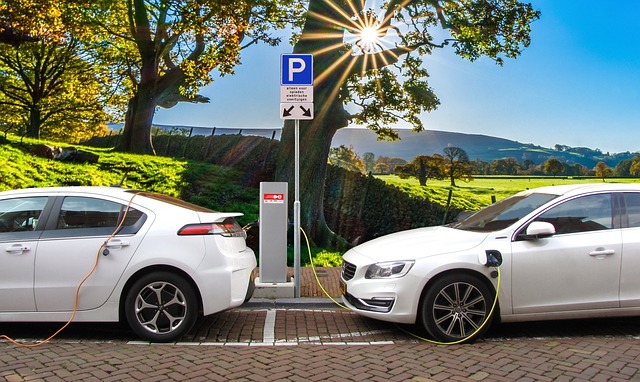
TORONTO – Among the federal government’s goals for the future, there is one that seems unattainable: by 2035, all new cars will have to meet the “zero emissions” requirement, that is: be electric. This was announced yesterday by the Minister of the Environment, Stephen Guilbeault, glossing over a not irrelevant detail: in Canada there are not enough “charging” stations, necessary for these machines to travel.
In fact, Natural Resources Canada estimates that Canada will need between 442,000 and 469,000 public charging points by 2035. Too bad there are currently only 10,425 charging stations and 25,246 charging ports based on data from the “charging station locator electricity and alternative supply”. And that’s a big problem according to Brian Kingston, president and CEO of the Canadian Vehicle Manufacturers’ Association: “We need significantly more public charging and multi-unit residential charging across the country if we want to get to electrification at the 100% in 2035” he said in an interview.
The minister, presenting the “zero emissions by 2035” initiative, however glossed over – as we were saying – throwing water on the fire: “There is still a need for infrastructure systems, for [travel] across the country, for longer distances. But in general, most EV owners will charge at home” Guilbeault said.
Among other things, as the CBC reports, in August, a report found that fewer than one in five federally funded chargers were operational. “There is a big gap between what we currently have and what is required” Kingston further said. “And if we want to hit these very aggressive sales goals, we need to see a massive buildout of charging infrastructure”. Kingston added that he thinks it’s the federal government’s job. “The primary responsibility for this infrastructure right now lies with the federal government, and the reason for that is they’re regulating the sale of these vehicles and they’re setting these targets,” he said.
But Josipa Petrunic, president and CEO of the non-profit Canadian Urban Transit Research & Innovation Consortium, doesn’t see it that way. “In truth the taxpayer has already ‘built’ enough” she said. “This is 100% an industry issue” and she added that the automotive sector should lead the charge because it has all the data on where charging points are needed and where they will be needed in the future. “They are the ones who need to start innovating to sell a car with charging service, just like Tesla did” she stressed, specifying that she sees a larger federal role in building infrastructure in northern, indigenous and rural communities that will have to, yes, be subsidized by the State, “this makes sense”, she added.
There is currently no single body that is implementing public charging infrastructure or deciding where to place “chargers” at the national level, while the “chargers” themselves are funded through a combination of federal, provincial, territorial and municipal governments, as well as of the private sector, especially in large urban areas.
But there is also another problem which concerns the charging of electric cars “at home” as the Minister of the Environment says. In fact, to make apartment buildings suitable for electric vehicles can cost hundreds to thousands of dollars if the transformers powering the complex need to be upgraded, said Olivier Trescases, a University of Toronto professor and chair holder of Canadian research on power electronic converters. “It really depends on whether the building has the electrical capacity, so the worst case is if everyone is charging at the same time while the air conditioning systems are running and so on” he said. In short: that of “electric-only vehicles starting from 2035” seems to be a beautiful fairy tale. Beautiful, but a fairy tale.