TORONTO – Toronto City Council has approved the increase of the vacancy tax from 1% to 3%. “Housing costs are so incredibly high, that’s why housing is the first topic before the City Council today” Mayor Olivia Chow told reporters before the City Council meeting Wednesday. “We are asking speculators who are leaving apartments empty, in the midst of a housing crisis, to pay a little more so we can raise millions and millions of dollars that we will use to purchase public buildings. These could be older buildings. but they’re affordable buildings. We want to protect these buildings so we can make them available to people to ensure that renters have affordable homes forever”.
The motion, proposed by Chow to transfer any additional revenue generated by the 2023 vacancy tax to the existing MURA (Multi-Unit Residential Acquisition) program, passed by a vote of 21-2 (Vincent Crisanti and Stephen Holyday voted “no”; absent 2).
The MURA program aims to preserve the existing supply of affordable rental housing in the city: the vacancy tax requires residential property owners in Toronto to make an annual declaration indicating whether their property was vacant or occupied and requires homeowners to pay a 1% tax on the assessed value of their property if it has been vacant for six months or more. The tax was adopted in 2021 and went into effect last year. In 2022, there were 2,336 property owners who declared their residential units vacant, while another 44,902 properties were deemed vacant by the Municipality because no declaration was made. Late declarations received through a complaints process reduced the number of homes deemed vacant to 17,437. Ultimately, the city raised $54 million through the tax in its first year of implementation.
Now that tax has been raised to 3% — the move is expected to generate about $50 million more, assuming the number of vacant homes stays about the same. However, the extra income could then decline, year after year, as the program begins to discourage people from leaving their homes empty. “The assumption is that this additional $50 million in revenue will decline by approximately 20% annually in subsequent years,” according to City staff. The tax increase, in short, should gradually discourage property owners from keeping their units unoccupied and will help offset the cost of the program.
City’s staff also recommended the introduction of a new fee of $21.24, to be adjusted annually for inflation, for failure to submit a property occupancy declaration by the annual deadline: this would raise around $800,000, which they would serve to cover the management costs of the program. Revenue from that fee will also decline as owners become more compliant with reporting. Reporting compliance for the first year of the program was 95% and City staff estimates it will improve by 1% each year.
Speaking in the Council on Wednesday, city councilor Stephen Holyday, who opposed to Chow’s motion, said he feared that the tax increase from 1% to 3% would become just a revenue tool rather than a political tool. “I don’t like this tax” he said, and he also proposed an exemption for people who vacate their homes due to health circumstances (for example, in the case of those forced to spend long periods in hospital): the City Council therefore approved a motion by Holyday to study the feasibility of exemptions for medical reasons.
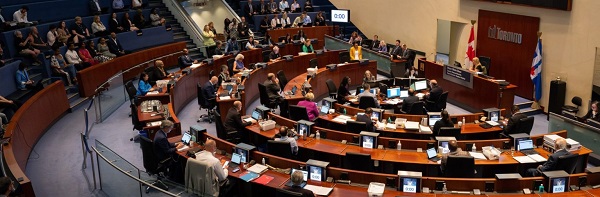
In the pic above, the Toronto City Council (photo from https://www.toronto.ca/city-government/council)