
TORONTO – The excitement was undeniable and could be felt throughout downtown around the stadium as well as in neighbourhood pubs across the city at every single match broadcast on tv. But according to early data, the economic results many had hoped for may not have materialized: Toronto appears to have received only a modest economic boost from the World Cup, which for Canada is already coming to an end following today’s final match on Canadian soil, Switzerland vs. Colombia in Vancouver.
According to the City of Toronto, a total of $380 million was spent by the municipal, provincial and federal governments to host the six matches held in the city. More than 300,000 international visitors had also been expected to arrive.
Against the backdrop of such a significant investment, credit card spending data provided to Global News (here) by payment processing company Moneris shows that consumer spending in Toronto increased only moderately between June 12 and June 26, remaining far below the levels reached during Taylor Swift’s 2024 Eras Tour.
Compared with the same period last year: hotel spending increased by 18%; restaurants and bars saw a modest 3% rise; big-box retailers and grocery stores recorded increases of 4% and 6% respectively; clothing sales actually declined by 5%.
Spending by international visitors using foreign-issued credit cards was much stronger. Visitors from outside Canada spent up to 34% more at restaurants and bars and 19% more at grocery stores. The only category with a more limited increase was hotels, which saw a 7% rise.
“This shows that tourists came, they went out to eat, they visited bars and restaurants before and after the games, and they were excited to celebrate,” said to Global News (here) Emily Abrahams, Moneris’ external communications manager.
But beyond that, the overall impact appears limited — especially when compared with the figures from Taylor Swift’s Eras Tour, which generated a 12% increase in restaurant spending and a 49% increase in clothing purchases, with average spending across all categories rising by 45%.
“It was a huge cultural phenomenon that echoed and reverberated around the world,” Abrahams said. “It’s really difficult to compare any event to Taylor Swift’s tour because it was truly a once-in-a-lifetime phenomenon.”
A study prepared by Deloitte Canada for FIFA, however, estimates that hosting the World Cup could generate, in the end, $940 million in positive economic output for the Greater Toronto Area, including a $520 million contribution to the region’s GDP.
Tourism industry representatives, including Destination Toronto, also believe the benefits of the tournament could extend well beyond its conclusion.
The organization surveyed international visitors at Toronto Stadium, where the World Cup matches were held, as well as at Fan Fest. Nine out of 10 respondents said they planned to return to Toronto within the next two years.
“The real value lies in the combination of those returning visitors and the fact that the event inspires other people to choose Toronto as a travel destination,” said Kelly Jackson, vice-president of Destination Toronto.
Time will tell.
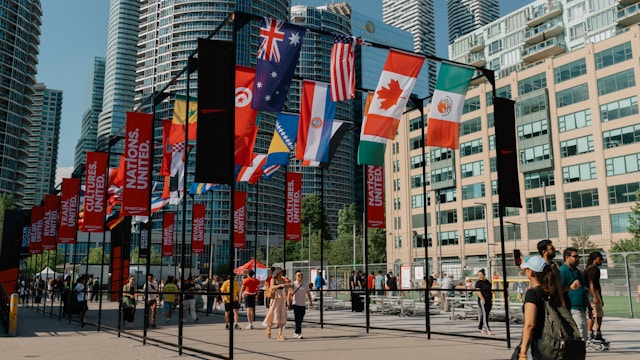
In the photo (by Frank Huang on Unsplash) Harbourfront Centre, Queens Quay West, Toronto, two weeks ago