TORONTO – The Ontario government has announced a reform of the Ontario Immigrant Nominee Program (OINP), the provincial immigration program that allows the province to nominate candidates for permanent residence based on labour market needs. The goal is to respond more quickly to labour shortages in key sectors of the economy while streamlining procedures for both workers and employers.
The reform, unveiled by the Ministry of Labour, Immigration, Training and Skills Development led by David Piccini, will reduce the current eight immigration streams to four, with stricter eligibility requirements, less bureaucratic overlap and more streamlined processes.
“Targeted skilled immigration is key to building our workforce and securing Ontario’s economic future,” said Minister Piccini. “By modernizing the Ontario Immigrant Nominee Program, our government is focusing on people with jobs and experience who can contribute to our ongoing work to protect Ontario’s economy quickly.”
The first of the four new streams, the Ontario Workforce Priority (OWP) stream, is already operational, while the remaining three are expected to be launched later this year.
This first new stream will connect eligible workers with job offers from Ontario employers, creating a pathway to permanent residence.
“Core stream components – the government said in a statement, available here – include:
- Minimum language and education requirements for applicants
- Work experience criteria that prioritize Ontario-based experience and direct linkages with employers
- New lower revenue thresholds so more smaller Northern and rural businesses can access the OINP for the first time
- Greater flexibility for applicants to qualify for related roles (e.g., someone who is currently a nurse could qualify to become a Personal Support Worker while they work on achieving credential equivalency)
The redesigned program builds on our government’s sustained effort to protect the integrity of Ontario’s immigration system and ensure it delivers for workers, families and employers.”
Indeed, the reform also aims to strengthen the integrity of Ontario’s immigration system, which has been undermined in the past by abuses that weakened public confidence in the program.
In announcing the reform, the provincial government also noted that demand for OINP nominations continues to far exceed the number of available spaces. In 2025, Ontario nominated 10,750 candidates for permanent residence to address critical labour shortages. During the same year, the program’s integrity team carried out 485 inspections of employers and applications, issuing 56 program bans and 76 administrative penalties to combat fraud.
The Expression of Interest (EOI) system, which served as the foundation of the OINP, was temporarily suspended on June 25 to facilitate the transition to the redesigned program and is expected to reopen later this summer. Applications already submitted under the previous system will continue to be processed according to the former rules.
The reform has received support from representatives of the legal community, the Ontario Chamber of Commerce and the construction sector, who described it as “an important step toward making Ontario’s immigration system more efficient, transparent and better aligned with the needs of businesses and the provincial economy.”
On the OINP website (here), the Government of Ontario encourages applicants to stay tuned for program updates, further announcements, and the reopening of the application portal.
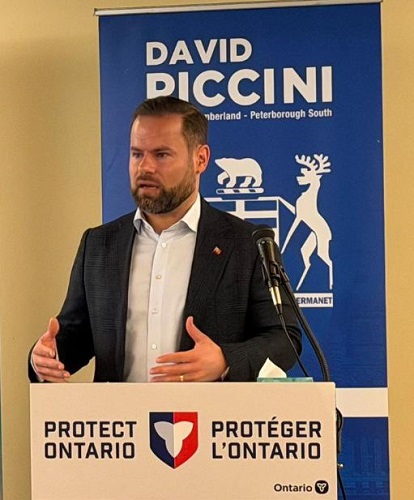
In the pic above, the Minister of Labour, Immigration, Training and Skills Development of Ontario, David Piccini (from Twitter X – @DavidPiccini)