
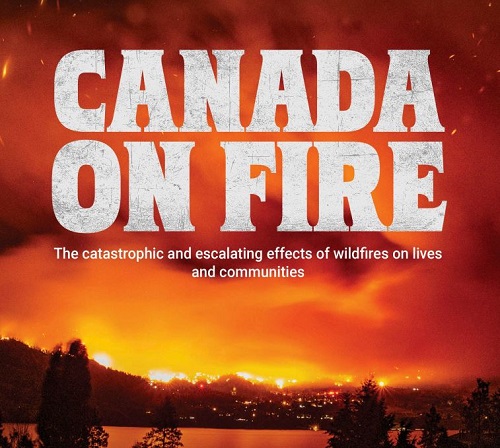
OTTAWA – After three consecutive record-breaking seasons, the Canadian Senate warns that wildfires have exceeded the response capacity of current systems and is calling on the federal government to act urgently. In a report with the telling title “Canada on fire”, published today (here), the Senate Committee on Agriculture and Forestry describes wildfires as a true national crisis, worsened by climate change and set to increasingly affect the population, economy, and territory.
Over the past ten years, Canada has recorded an average of more than 5,000 wildfires per year, with around 2.9 million hectares burned annually. The year 2023 set an all-time record: 6,837 fires devastated 14.6 million hectares of land and forced more than 232,000 people to evacuate. According to the report, the exceptional fire seasons of 2023, 2024, and 2025 show that wildfire behaviour is changing rapidly and that current systems are no longer adequate to deal with the phenomenon: for example – according to the report – during the record-breaking 2023 season, only half of Canada’s fire departments had the necessary equipment to respond to wildfires.
The consequences go far beyond the destruction of forests. Millions of Canadians are exposed for days or weeks to toxic wildfire smoke, with significant effects on both physical and mental health. Children, the elderly, pregnant women, people with chronic illnesses, and remote Indigenous communities are particularly vulnerable.
The report also stresses that the economic costs associated with smoke pollution are now exceeding those incurred for firefighting operations. Indigenous communities are especially affected, often located in remote or forested areas. Many have experienced repeated evacuations, loss of homes, and severe economic damage. Despite their long-standing tradition of fire management and knowledge considered valuable by experts, these communities remain underrepresented in decision-making processes and have limited resources to respond to emergencies.
The forestry and agricultural sectors are also paying a high price. Wildfires reduce timber availability, damage infrastructure and supply chains, and threaten the economic survival of many rural communities. Farmers face crop losses, livestock deaths, equipment damage, and land destruction, while insurance costs rise and public support programs are considered too slow and ineffective.
One of the main issues identified by the Senate committee is the fragmentation of responsibilities. Fire management is shared between provincial, federal, and local governments, without a single coordinating authority. According to the report, this leads to delays in response, inconsistent planning, and uneven distribution of personnel and equipment.
To address the crisis, the Senate proposes fifteen recommendations, including the creation of a federal wildfire coordination office, the establishment of a national aerial firefighting fleet, increased investment in monitoring and forecasting technologies, a national wildfire risk mapping system, and strengthened operational capacity for Indigenous communities. The report also calls for a national reforestation policy, new fire-resilient building standards, and increased funding for rebuilding damaged infrastructure.
The report also highlights that Canada holds around 9% of the world’s forests and that the forestry sector is one of the pillars of the national economy, contributing over 30 billion dollars to GDP in 2024 and supporting more than 300 communities directly dependent on the timber industry.
The final message of the report is clear: wildfires can no longer be treated as seasonal emergencies. They have become a structural threat to the country and require a coordinated, permanent response proportional to the scale of the crisis. As Senator Mary Robinson, chair of the committee, states: “Governments must adapt their response to match the scale of the crisis and mobilize at the speed of the flames.”
The report was presented today at Parliament Hill in Ottawa by Senators Mary Robinson, Chair of the committee, John M. McNair, Deputy Chair of the committee, and Manuelle Oudar, as well as Ken McMullen, President of the Canadian Association of Fire Chiefs.Officers.
To read or download the full report, click here: CANADA ON FIRE