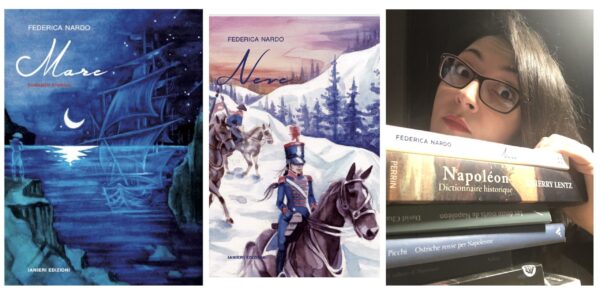
“I’m not a writer, I’m simply a graphomaniac who is trying to become one!” she writes about herself in her Facebook profile: in the meantime, however, the Italian newspaper ‘Libero’ has dedicated an entire page to her, signed by Vittorio Feltri. Her two historical novels, which tell of a Napoleon in love with an (imaginary) woman who will change him forever, provoke discussions, debates … in short: they work.
We are talking about Federica Nardo (in the pic above, near the covers of her books), a young Italian writer born in 1992 in Avola in the province of Syracuse, Sicily, and grown up between Pachino and Catania. Classical high school diploma, studies in Law at the University of Florence and at the Sorbonne in Paris and then full immersion in the story of her “great love”: Napoleon Bonaparte. A love that led her to make the great leader (whose bicentenary of death occurs just this year) the protagonist of her stories. We tried asking her why, to find out more.
Federica, why did you decide to dedicate your first two historical novels (with the third in preparation, right?) to Napoleon? What struck you, so much, about this character? “My passion for Napoleon Bonaparte began when I was about 11 years old: on the Italian television channel Rai1, they broadcast a dedicated fiction and for me it was a ‘love at first sight’. I immediately fell in love with the events of a man who had built himself, starting from an island where he was destined to become a simple landowner and with the strength of his genius he became emperor of half of Europe. From there I decided to learn French and then finish university in France just to be able to dedicate myself, in addition to university studies, to my greatest passion. My first two novels are the result of sources collected in over a decade of studies: I realized that in Italy the knowledge of the character Napoleon is relegated to a few chapters of school texts where obviously the general, the strategist, the emperor and never man. I wanted to tell the “behind the scenes” of history, the Napoleon beyond Bonaparte ”.
You have delved deeply into the Emperor’s life. The character of your stories, Nives, is fictional but did the “Napoleon in love” really exist? Two wives, three or perhaps four illegitimate children, a long list of lovers … who really was the general? “Napoleon from the scholastic history is told to us as a rather misogynistic tombeur de femmes, accustomed to using women for his pleasure and with an unknown number of lovers and children around the world, one in each port. It is not really like that! Napoleon said of himself that he was not made for love: probably the bad weather to which life had subjected him, his military training and reason of state had made his character and his way of relating to others angular. Moreover, not being attractive and having her mother as an ideal model of a woman, Letizia Ramolino – a woman with a tough character and capable of managing the Bonaparte clan alone, as a widow and in her early twenties – her relationship with the fairer sex shouldn’t have be simple. We must also consider the nineteenth-century vision: after the Revolution women were no longer totally submissive, but they were not totally free either. Yet if we look at the letters that the general addressed to his first wife, Josèphine De Beauharnais, we find a man overwhelmed by passion, we could compare him to a teenager in his first crush. Furthermore, the strong sentimental whirlwind that enveloped him when he met Countess Maria Walewska should not be forgotten. So I can say that the Napoleon in love really existed, the Napoleon a man far from the battlefields and I wanted to tell it through the eyes of Nives, my protagonist “.
“Snow” (“Neve”), “Sea” (“Mare”) … what will be the title of the last act of the trilogy? “I haven’t decided yet… I’m very torn between two titles, always made up of a single word. Lately I have been playing with the idea of turning the trilogy I had in mind into a quadrilogy. Who knows! “.
And after Napoleon? Do you already have another character in mind to fictionalize or will your first “historical” love also remain the only one? “I believe that Napoleon will always remain my only ‘historical love’: I have practically devoted my entire life to deepening every aspect of his great imperial epic. Writing about history is a long and demanding job: you have to consult the sources, immerse yourself in dusty archives, read biographies and essays. It would probably take me another life to deepen another historical character and I would certainly not write about him or her animated by the same historical passion that prompted me to tell Bonaparte. However, I do not set limits: del doman non v’è certezza! (there is no certainty about tomorrow!)”.
You also wrote a fable, “August Flower”: will it remain an isolated episode or do you have others in the drawer? ” ‘Fiore d’agosto’ (‘August Flower’) was a quarantine experiment, I published it in self on amazon taken from a writing spurt and without bothering my editor for a ten-page essay. My second novel, ‘Mare’, had been out a few months ago and I was starting to lay the foundations for the third, but I wanted to write more and share it. I have always liked writing fairy tales, as a child I did it often, I began to understand that I liked to tell others just by inventing short stories. Probably sooner or later I will write a collection intended for children, but also for adults: ‘Fiore d’agosto’ is written with a double interpretation ”.
For those wishing to buy the novels, they can be found online on Amazon (“Mare” also in ebooks), in all online bookstores and on the website of the Ianieri Edizioni publishing house https://www.ianieriedizioni.com/?post_type=product&s=Federica+ Nardo