
TORONTO – With smoke from wildfires burning across the Prairies now reaching as far as Europe, could there be a risk to air quality in Toronto and the GTA?
Environment Canada meteorologist Barbara Lapido told CTV that many people in Southern Ontario could see hazy skies and reddish sunrises and sunsets over the next couple of days. “Some of that smoke (from the forest fires), it’s being kind of transported into southern Ontario, but it’s not affecting the surface in southern Ontario” Lapido said, and that’s why there are no air quality warnings in effect for that part of Ontario.
Northern Ontario is, instead, more affected by wildfire smoke, according to the director of the Southern Ontario Centre for Atmospheric Aerosol Research. “It’s improved since (Monday night) but it’s still, I would say, six to eight times higher than it is in Toronto, the level of particles in the air” Greg Evans said.
Not surprisingly, indeed, air quality alerts are in effect in those Northern areas of Ontario, as well as in an area of Quebec and in several areas of five other provinces: Alberta, British Columbia, Manitoba, Saskatchewan and the Northwest Territories (follow the updatings here).
These microscopic particles of the smoke, formally called “particulate matter”, help determine the level of smoke or pollution in the air, which then affects the Air Quality Index (AQHI). “When you have a high concentration of them, it creates a haze; once you start seeing that haze, it means the concentrations are pretty high…” Evans explained.
Jeff Brook, associate professor at the Dalla Lana School of Public Health, believes what we’re seeing now with wildfires is an indicator of potential concern for the summer. “I know that the summer predictions are for there to be considerable heat and dryness in western Canada, and so that means that it’s going to be a constant battle to deal with fires and the way the atmosphere moves things” Brook told CTV. “We can expect intermittent milky skies…”.
The energy from wildfires can push fine particles quite high into the Earth’s atmosphere and into the jet stream, Brook said, carrying them far away. And it already happened, in recent days: the intensity of the fires in Manitoba and Saskatchewan has pushed the smoke from Canadian wildfires across the Atlantic toward Europe. As we reported in a previous article, the Copernicus Atmosphere Monitoring Service (CAMS) has been monitoring Canadian smoke plumes all the way to Europe, with more “waves” expected in the coming days.
While it’s difficult to predict how smoke from the Prairie wildfires will continue to affect neighboring regions in the coming weeks, Greg Evans says it will depend on wind direction, which in turn depends largely on the direction of the jet stream, a narrow current of air in the upper atmosphere. One advantage for Toronto and Southern Ontario, Evan notes, is that spring weather has started later this season.
“We’ve had rainy weather, colder weather in southern Ontario, and that’s because we’re on the northern side of the jet stream whereas out west, they’ve had some very hot weather” Evans explained. “So, the drawback of having this late spring has actually been beneficial for us in terms of avoiding plumes”.
In the event of future air quality alerts, if the AQHI gets too high, Barbara Lapido recommends avoiding exercise and spending more time indoors with windows closed. There are also long-term impacts from breathing in high amounts of particulate matter from wildfire smoke, if it stays in the air for a while, Evans notes. “The long-term effects are numerous. It’s both cardiac—so the vulnerability to heart attacks, vulnerability to stroke, vulnerability to respiratory problems” Evans said. “More recently, there’s been connections made to reproductive health, cognitive development, neurological health, cancer—it’s right across the board…”.
The fire burns, but its smoke could do even more harm. In a more subtle way.
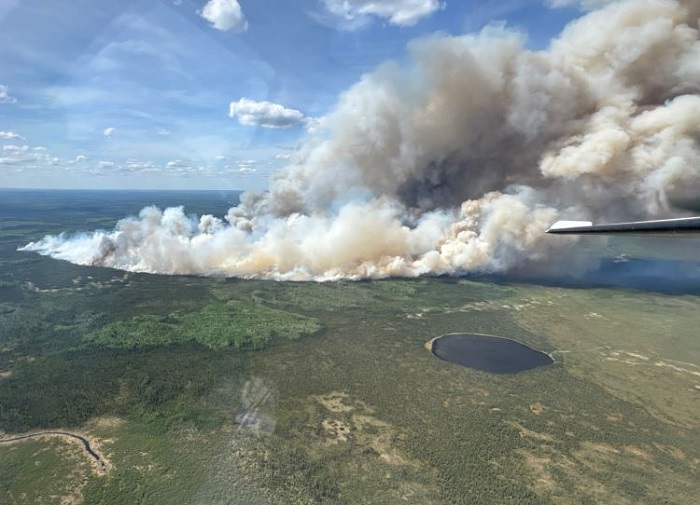
In the pic above, a wildfire in Alberta (photo from Twitter X – @AlbertaWildfire)