

TORONTO – The divisions between the Conservatives and Ppc penalized Erin O’Toole. Three days after the federal vote, with the final data of Elections Canada, it is possible to carry out a comparative analysis of the total preferences received by the various parties running in all Canadian constituencies.
Well, there are 21 federal districts where the sum of the votes for the conservative candidates and those of Maxime Bernier’s People’s Party is higher than the total of the preferences obtained by the candidate who finally won the seat. In practice, if there had not been a split between the two sections of the Canadian right, in these 21 districts the conservative candidate would have won.
Now, this analysis starts from a very specific assumption, that is that the voter who voted for Bernier’s candidate, in the absence of alternatives, would have diverted his preference to O’Toole’s candidate.
This is obviously a generalization, but it has a very solid foundation. The PPC voter would hardly have supported the candidate of Justin Trudeau’s party, just as it seems a gamble to hypothesize a possible vote on the left, for the NDP or for the Green Party.
But numerically, which parties benefited from the split on the right? According to the final data of Elections Canada, in fourteen districts it was the liberal candidate who won it, in six that of the NDP and in one that of the Bloc Quebecois. The constituencies in question are located in Ontario – as many as twelve – in British Columbia (five), Alberta (two), Quebec and Labrador and Newfoundland (one in both).
Now it remains to be asked how the political geography in the House of Commons would actually have changed: if on the one hand it is true that the Liberal Party would have come out greatly weakened, on the other it is verifiable how Trudeau’s party would still have maintained a very small relative majority in the House.
The Liberals would have gone from 158 seats to 144, the Conservatives would have risen from 119 to 140, the Neo-Democrats would have fallen from 25 to 19 while the Bloc Quebecois would have lost one seat, going from 34 to 33.
In short, we would have been faced with an even more fragmented and divided parliamentary hall, with the majority party clinging to very fragile balances to continue governing. But that’s not all.
Right now the executive led by Trudeau, to carry out its political agenda as in the last legislature, simply needs the indirect support of the neo-democrats of Jagmeet Sing: with their votes an absolute majority is achieved in the House of Commons.
With the second scenario just analyzed, however, the sum of the liberal and ndippini deputies reaches 159, 11 less than the necessary threshold of 170.
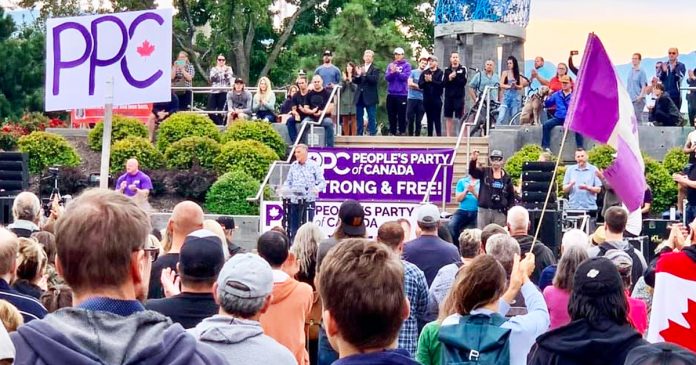
These indicators make it clear how relevant bernier’s election result was, riding the protest of the no vax and anti-lockdown, of those who oppose vaccination passports or who even deny the existence of Covid, made inroads into the Canadian electorate, taking 834,426 equal to 5 percent of voters.
The Greens, who unlike Bernier’s party were able to elect two candidates, came in at 2.3 percent of the vote, with 387,456 votes.
Bernier has already announced that his political project will continue even after these elections, outside the parliament.
Trudeau, paradoxically, has found his best ally in former government minister Harper, while O’Toole has paid and will continue to pay dearly for Bernier’s cumbersome presence on the right, with the risk of a potential shift of the conservative electorate in the immediate future.