TORONTO – What we have been smelling in recent weeks in Toronto is not just the “smell of smoke”. There is that acrid “aftertaste” of plastic and, unfortunately, it’s not just an impression: experts confirm it.
Smoke exposed to sunlight and its UV (ultraviolet) rays can create a chemical reaction that results in the creation of benzene and formaldehyde, which smell like plastic, according to Dr Michael Fitzpatrick, a professor of Medicine at Queen’s University specializing in Respirology. The reaction with UV light can happen quickly, Fitzpatrick told Global News, but the result of the smell depends on the concentration of “volatile organic compounds” that are released from the fire. A mix that, certainly, is not good for health. The presence of formaldehyde in the air can cause eye and throat irritation, while benzene can cause drowsiness, headache and rapid heartbeat. Not only that: benzene – Fitzpatrick underlined again – can be carcinogenic, even if most people will not be exposed to a quantity high enough to be worrying. However, Fitzpatrick himself advises not to go out, if possible, on days when the smoke is intense or, if you go out, to wear a mask and keep windows and doors closed when you are at home.
Meanwhile, residents of major cities in Canada and the United States are once again experiencing smoggy and hazy conditions due to the fires in Ontario and Quebec. Toronto in particular had one of the worst air quality in the world last week. And the emergency continues. In the US, more than 100 million people are on air quality alerts from Wisconsin to Vermont and as far north as North Carolina as smoke from Canada’s wildfires continues to waft south. Air quality on both sides of the border has been compromised by more than 500 active wildfires raging across Canada. Some fires are so out of control that officials have no choice but to let them burn.
But why is it so difficult to tame them? Massive wildfires burning in remote areas, such as some of the ones currently burning in northwest Quebec, do not directly threaten people, infrastructure, watersheds, so available resources must be directed towards other wildfires that do threaten human life and its infrastructure. “There have always been fires that Canadian firefighters don’t fight. It’s expensive to do and, in a way, you’re messing with nature”, said Daniel Perrakis, a fire scientist with the Canadian Forest Service. “Smoke is a problem but even if we wanted to do something about it, it wouldn’t really be clear how to do it. We’re talking about large areas where there’s no road access, no community”.
And then there is an operator safety issue. “Some of the fires have been allowed to burn because they are too treacherous for firefighters to attempt to tackle. These fires are so big that you really can’t let anyone get near them – the winds pick up, they move really fast and can trapping crews” Robert Gray, a Canadian bushfire ecologist, told CNN. And in any case, although ten countries of the world have sent firefighters to help Canada, resources are not enough: there are too many fires. Of the 522 fires active over the weekend, 262 are listed as out of control across Canada: in British Columbia, Alberta, Ontario and Quebec in particular.
Meanwhile, scientists continue to reiterate warnings that the effects of climate change are upon us, pointing out that forest fires, with their accompanying clouds of toxic smoke they generate, will become more frequent as rising temperatures and droughts favor the outbreak of fires. With all the consequences of the case, toxic smoke in the first place. “People will probably have to get used to it,” Perrakis said. “Climate change is undeniable and now is the time to think about the future and what needs to be done”. Before it’s too late, if it isn’t already.
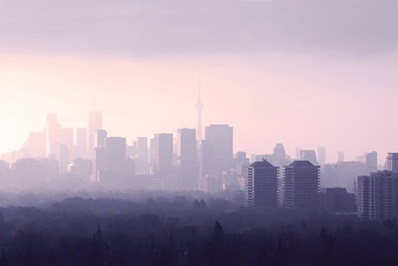
In the pic above, Toronto shrouded in smoke in a photo posted on Twitter a few days ago by Toronto Public Health (@TOPublicHealth)